
JN0-480 · Question #56
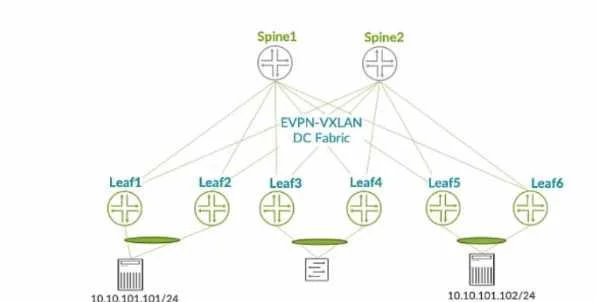
In the EVPN-VXLAN data center fabric bridged overlay architecture shown in the exhibit, the servers are connected to Lead and Leat6 using the same virtual network identifier (VNI). Which two…
The correct answer is C. Loopback IPv4 addresses must be advertised into the EBGP underlay from leaf and spine devices. D. The underlay EBGP peering's must be established between leaf and spine devices. In the EVPN-VXLAN data center fabric bridged overlay architecture shown in the exhibit, the servers are connected to Leaf1 and Leaf6 using the same virtual network identifier (VNI). This means that the servers belong to the same Layer 2 domain and can communicate with each…
Question
In the EVPN-VXLAN data center fabric bridged overlay architecture shown in the exhibit, the servers are connected to Lead and Leat6 using the same virtual network identifier (VNI). Which two statements are correct in this scenario? (Choose two.)
Exhibit
Options
- AThe underlay must use IRB interfaces.
- BThe underlay must be provisioned with PIMv2.
- CLoopback IPv4 addresses must be advertised into the EBGP underlay from leaf and spine devices.
- DThe underlay EBGP peering's must be established between leaf and spine devices.
How the community answered
(34 responses)- A12% (4)
- B9% (3)
- C79% (27)
Explanation
In the EVPN-VXLAN data center fabric bridged overlay architecture shown in the exhibit, the servers are connected to Leaf1 and Leaf6 using the same virtual network identifier (VNI). This means that the servers belong to the same Layer 2 domain and can communicate with each other using VXLAN tunnels across the fabric. The underlay network provides the IP connectivity between the leaf and spine devices, and it uses EBGP as the routing protocol. Therefore, the following two statements are correct in this scenario: Loopback IPv4 addresses must be advertised into the EBGP underlay from leaf and spine devices. This is because the loopback addresses are used as the source and destination IP addresses for the VXLAN tunnels, and they must be reachable by all the devices in the fabric. The loopback addresses are also used as the router IDs and the BGP peer addresses for the The underlay EBGP peering's must be established between leaf and spine devices. This is because the EBGP sessions are used to exchange the underlay routing information and the EVPN routes for the overlay network. The EBGP sessions are established using the loopback addresses of the devices, and they follow a spine-and-leaf topology, where each leaf device peers with all the spine devices, and each spine device peers with all the leaf devices.
Topics
Community Discussion
No community discussion yet for this question.