JN0-480 · Question #50
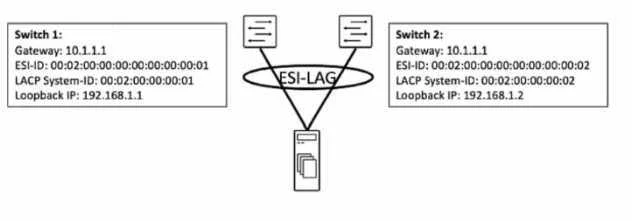
You are working to build an ESI-LAG for a multihomed server. The ESI-LAG is not coming up as multihomed. Referring to the exhibit, what are two solutions to this problem? (Choose two.)
The correct answer is B. The LACP system ID on both devices must be the same. D. The ESI ID on both devices must be the same. An ESI-LAG is a link aggregation group (LAG) that spans two or more devices and is identified by an Ethernet segment identifier (ESI). An ESI-LAG provides redundancy and load balancing for a multihomed server in an EVPN-VXLAN network. To configure an ESI-LAG, you need to ensure…
Question
You are working to build an ESI-LAG for a multihomed server. The ESI-LAG is not coming up as multihomed. Referring to the exhibit, what are two solutions to this problem? (Choose two.)
Exhibit
Options
- AThe gateway IP addresses on both devices must be different.
- BThe LACP system ID on both devices must be the same.
- CThe loopback IP addresses on both devices must be the same.
- DThe ESI ID on both devices must be the same.
How the community answered
(47 responses)- A19% (9)
- B74% (35)
- C6% (3)
Explanation
An ESI-LAG is a link aggregation group (LAG) that spans two or more devices and is identified by an Ethernet segment identifier (ESI). An ESI-LAG provides redundancy and load balancing for a multihomed server in an EVPN-VXLAN network. To configure an ESI-LAG, you need to ensure that the following requirements are met: The LACP system ID on both devices must be the same. This ensures that the LACP protocol can negotiate the LAG parameters and form a single logical interface for the server. The ESI ID on both devices must be the same. This ensures that the EVPN control plane can advertise the ESI-LAG as a single Ethernet segment and synchronize the MAC and IP addresses of the server across the devices. The VLAN ID and VNI on both devices must be the same. This ensures that the server can communicate with other hosts in the same virtual network and that the VXLAN encapsulation and decapsulation can work properly. In the exhibit, the LACP system ID and the ESI ID on both devices are different, which prevents the ESI-LAG from coming up as multihomed. Therefore, the correct answer is B and D. The LACP system ID on both devices must be the same and the ESI ID on both devices must be the
Topics
Community Discussion
No community discussion yet for this question.
