HPE7-A06 · Question #75
Drag and Drop Question Match the network technology to the customer requirement. Answer:
The correct answer is ECMP; VXLAN; VNI; EVPN. Important Note The question is incomplete as presented - the customer requirements (the left-side slots to match against) are missing. Only the answer arrangement is shown. I'll reconstruct the most common version of this question (Cisco CCNP/DC exam style) and explain each…
Question
Drag and Drop Question Match the network technology to the customer requirement. Answer:
Exhibit
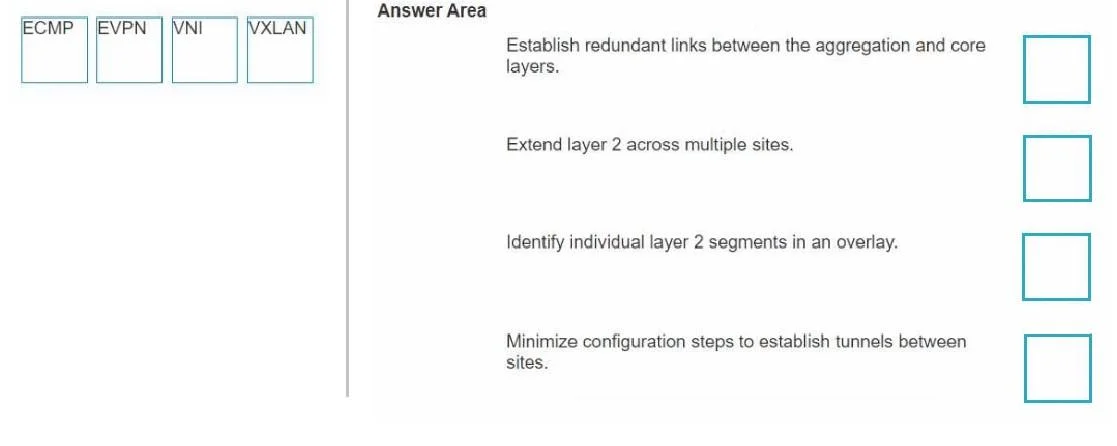
Answer Area
Drag items
Correct arrangement
- ECMP
- VXLAN
- VNI
- EVPN
Explanation
Important Note
The question is incomplete as presented - the customer requirements (the left-side slots to match against) are missing. Only the answer arrangement is shown. I'll reconstruct the most common version of this question (Cisco CCNP/DC exam style) and explain each placement.
Reconstructed Question (Standard Format)
| # | Customer Requirement | Technology |
|---|---|---|
| 1 | Load-balance traffic across multiple equal-cost paths | ECMP |
| 2 | Extend Layer 2 segments across a Layer 3 underlay network | VXLAN |
| 3 | Uniquely identify a virtual network segment in the overlay | VNI |
| 4 | Distribute MAC/IP reachability information in the overlay control plane | EVPN |
Item-by-Item Explanation
1. ECMP (Equal-Cost Multi-Path)
Role: Underlay load balancing.
ECMP allows traffic to be distributed across multiple paths that have the same routing cost. In data center fabrics (spine-leaf), ECMP is what makes the physical underlay efficient - packets to the same destination can use any of several equal-cost links simultaneously.
Common mistake: Confusing ECMP with bonding/LAG. ECMP is a routing-layer decision; LAG is link-layer aggregation. They're complementary but different.
2. VXLAN (Virtual Extensible LAN)
Role: The overlay encapsulation protocol.
VXLAN wraps Layer 2 Ethernet frames inside UDP/IP packets, allowing Layer 2 domains to stretch across a Layer 3 IP network. It solves the VLAN scalability limit (4094 VLANs) by using a 24-bit VNI field, enabling ~16 million segments.
Common mistake: Thinking VXLAN is only for VMs. It applies to any workload needing L2 extension across L3 boundaries.
3. VNI (Virtual Network Identifier)
Role: Segment identifier within the VXLAN overlay.
The VNI is the 24-bit field inside the VXLAN header that identifies which virtual network a frame belongs to. It's the VXLAN equivalent of a VLAN ID - but with far greater scale.
Common mistake: Treating VNI and VLAN as interchangeable. A VNI maps to a VLAN locally on a VTEP, but the VNI travels in the tunnel header, not the VLAN tag.
4. EVPN (Ethernet VPN)
Role: Control plane for the overlay.
EVPN (typically carried over MP-BGP) replaces flood-and-learn with a structured control plane. VTEPs advertise MAC and IP reachability using BGP EVPN route types, eliminating BUM (Broadcast, Unknown unicast, Multicast) flooding and enabling faster, more scalable MAC/IP distribution.
Common mistake: Thinking EVPN is the overlay. EVPN is the control plane - VXLAN is the data plane. They work together: EVPN tells VTEPs where endpoints are; VXLAN carries the actual traffic.
How These Four Fit Together
Underlay: IP network + ECMP (load balancing)
↓
Overlay: VXLAN (encapsulation/tunneling)
↓
Segment ID: VNI (identifies which virtual network)
↓
Control: EVPN (advertises MAC/IP, replaces flooding)
Think of it as layers: ECMP optimizes the roads, VXLAN builds the tunnels, VNI labels the cargo, and EVPN is the dispatch system that knows where everything should go.
Topics
Community Discussion
No community discussion yet for this question.
