
HPE7-A06 · Question #68
Drag and Drop Question Match the network technology to the customer requirement. Answer:
The correct answer is VSX; VXLAN; VNI; EVPN. Important Note on Missing Context The question is incomplete as provided - the customer requirements (the left-side items to match against) are not shown. The arrangement tells us the answer, but not what each position corresponds to. That said, based on common HPE Aruba…
Question
Exhibit
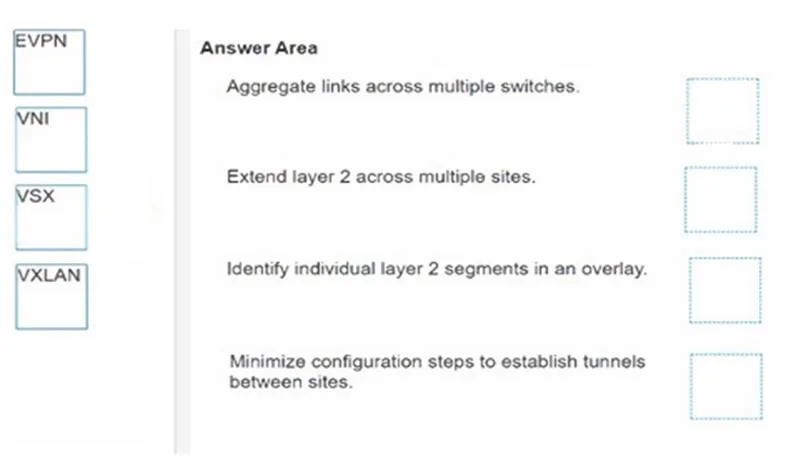
Answer Area
Drag items
Correct arrangement
- VSX
- VXLAN
- VNI
- EVPN
Explanation
Important Note on Missing Context
The question is incomplete as provided - the customer requirements (the left-side items to match against) are not shown. The arrangement tells us the answer, but not what each position corresponds to.
That said, based on common HPE Aruba certification exam formats, here is the most likely mapping and the technical reasoning:
The Technologies Explained
1. VSX - Virtual Switching Extension
Likely requirement: Active-active multi-chassis redundancy / eliminate Spanning Tree
VSX is HPE Aruba's proprietary solution for creating a logical single switch from two physical switches, providing active-active uplinks without STP. It operates at the physical/chassis layer, making it the foundation - hence position 1.
Common misconception: VSX is often confused with MCLAG. VSX is HPE-specific and provides deeper integration (shared control plane, ISL for sync).
2. VXLAN - Virtual Extensible LAN
Likely requirement: Extend Layer 2 over a Layer 3 fabric / overlay network
VXLAN encapsulates Layer 2 frames in UDP/IP packets, enabling L2 domains to span L3 boundaries. It's the data plane overlay - the tunnel technology itself.
Common misconception: VXLAN alone has no control plane. Without EVPN, MAC learning is flood-and-learn, which is why EVPN is paired with it.
3. VNI - VXLAN Network Identifier
Likely requirement: Segment/isolate tenant traffic within the overlay
A VNI is the 24-bit identifier (up to ~16 million segments) that functions like a VLAN ID inside a VXLAN tunnel. It identifies which logical network a frame belongs to.
Common misconception: VNIs are not VLANs - they exist only within the VXLAN encapsulation and don't propagate outside the overlay.
4. EVPN - Ethernet VPN
Likely requirement: Provide a scalable BGP-based control plane for MAC/IP distribution
EVPN uses MP-BGP to advertise MAC and IP reachability across VTEPs, replacing flood-and-learn. It's the control plane that makes VXLAN production-grade.
Common misconception: EVPN is often thought of as a separate overlay - it's actually the control plane for VXLAN, not an alternative to it.
Logical Ordering Takeaway
| # | Technology | Layer/Role |
|---|---|---|
| 1 | VSX | Physical redundancy (chassis layer) |
| 2 | VXLAN | Data plane overlay (encapsulation) |
| 3 | VNI | Segmentation identifier (within overlay) |
| 4 | EVPN | Control plane (MAC/IP signaling) |
If you can share the actual customer requirement statements, I can give a precise match explanation.
Topics
Community Discussion
No community discussion yet for this question.