HPE7-A06 · Question #70
Drag and Drop Question Match the customer requirement with commands used to partially configure the network technology used to fulfill the requirement. Answer:
The correct answer is interface vlan 1 no shutdown source ip 10.1.0.4; vni 11 vtep-peer 10.1.0.5 vlan 11; vxlan role primary interface lag 256 route-target both 64510:10010 source 192.168.0.1 vrf KA; vif overlay vni 10.1.0.2:10010 route-target both 64510:10010 bgpn. Drag-and-Drop Question Breakdown: VXLAN/Overlay Network Configuration Matching This question asks you to match customer requirements to partial configuration snippets across different network platforms/technologies. Each snippet represents a different vendor's or technology's…
Question
Drag and Drop Question Match the customer requirement with commands used to partially configure the network technology used to fulfill the requirement. Answer:
Exhibit
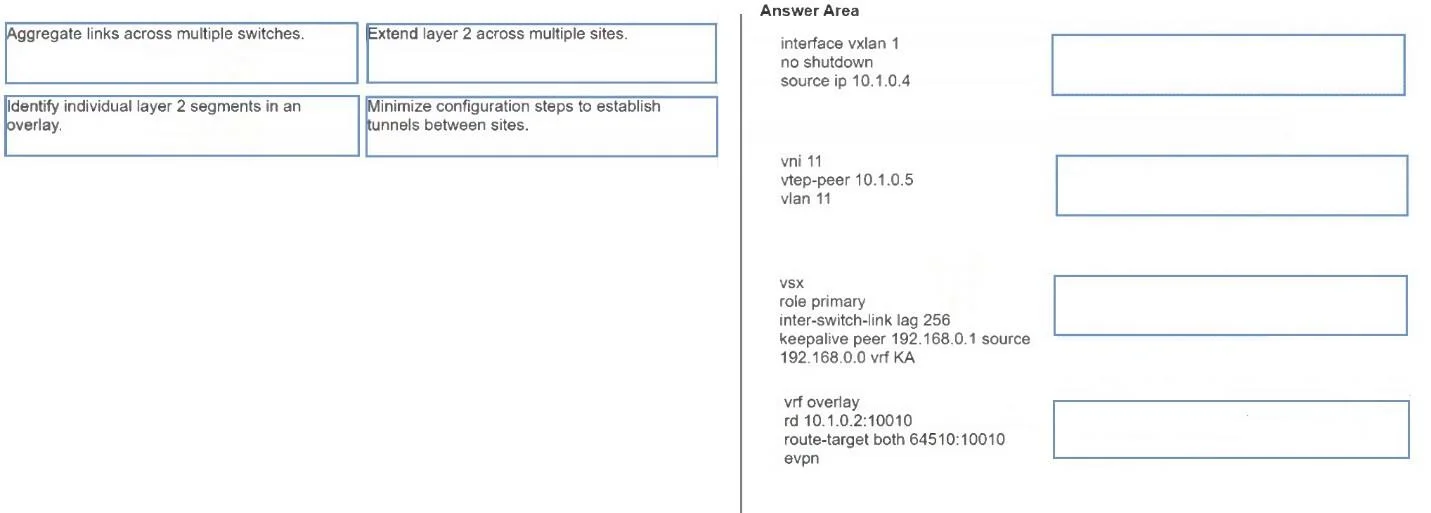
Answer Area
Drag items
Correct arrangement
- interface vlan 1 no shutdown source ip 10.1.0.4
- vni 11 vtep-peer 10.1.0.5 vlan 11
- vxlan role primary interface lag 256 route-target both 64510:10010 source 192.168.0.1 vrf KA
- vif overlay vni 10.1.0.2:10010 route-target both 64510:10010 bgpn
Explanation
Drag-and-Drop Question Breakdown: VXLAN/Overlay Network Configuration Matching
This question asks you to match customer requirements to partial configuration snippets across different network platforms/technologies. Each snippet represents a different vendor's or technology's approach to VXLAN/overlay networking.
Item 1: interface vlan 1 no shutdown source ip 10.1.0.4
Technology: VXLAN VTEP source IP configuration (likely Aruba CX or HPE FlexFabric syntax).
What it does: Brings up a VLAN interface and assigns it as the VTEP (VXLAN Tunnel Endpoint) source address. The source ip clause defines the local tunnel origination point.
Requirement it fulfills: A customer needing a basic VXLAN overlay where the tunnel source is explicitly bound to a specific IP (10.1.0.4) on VLAN 1.
Common mistake: Confusing source ip here with a regular SVI IP assignment - this is setting the VTEP identity, not just routing.
Item 2: vni 11 vtep-peer 10.1.0.5 vlan 11
Technology: Static/manual VXLAN (likely Aruba or HPE switch syntax).
What it does: Maps VNI 11 to VLAN 11 and statically specifies a remote VTEP peer at 10.1.0.5. No BGP/EVPN control plane - this is flood-and-learn or static peer VXLAN.
Requirement it fulfills: A customer needing a simple point-to-point VXLAN tunnel between two known endpoints, without a dynamic control plane.
Common mistake: Assuming this implies EVPN. The explicit vtep-peer without any BGP route-target means this is static VXLAN, not BGP EVPN.
Item 3: vxlan role primary interface lag 256 route-target both 64510:10010 source 192.168.0.1 vrf KA
Technology: Extreme Networks EXOS - EVPN-VXLAN with redundancy and L3VPN.
What it does:
role primary- this device is the active node in a redundant VTEP pair (MLAG/ESI)interface lag 256- uplink for the VXLAN fabricroute-target both 64510:10010- BGP EVPN import/export policysource 192.168.0.1- VTEP source IPvrf KA- L3 VPN / tenant VRF
Requirement it fulfills: A customer needing high-availability EVPN-VXLAN with L3 tenant isolation (VRF) and redundant gateway behavior.
Common mistake: Overlooking role primary - this isn't just any VXLAN config; it signals active/standby VTEP redundancy, which is a specific requirement.
Item 4: vif overlay vni 10.1.0.2:10010 route-target both 64510:10010 bgpn
Technology: Likely Pluribus Networks or a similar SDN fabric platform using BGP EVPN (bgpn = BGP-n/EVPN signaling).
What it does: Creates a virtual interface overlay binding an IP:VNI pair (10.1.0.2:10010) with BGP EVPN route-target policy. The bgpn keyword activates the EVPN control plane for this VNI.
Requirement it fulfills: A customer needing BGP EVPN-driven VXLAN on an SDN/programmable fabric where VNI-to-IP mappings are distributed dynamically.
Common mistake: Confusing vif overlay with a standard VLAN/SVI - this is a vendor-specific construct for overlay virtual interfaces, not a traditional Layer 2/3 interface.
Why This Arrangement Is Correct
| Position | Item | Key Differentiator |
|---|---|---|
| 1 | VLAN-based VTEP source | Simple VTEP IP binding |
| 2 | Static VNI + VTEP peer | No control plane, manual peering |
| 3 | Extreme EVPN + VRF + HA | Redundancy + L3VPN |
| 4 | Overlay VIF + BGP EVPN | SDN fabric, dynamic EVPN |
The arrangement progresses from simpler (static) to more complex (dynamic EVPN with HA/VRF), and each snippet's syntax is vendor/platform-specific - the exam is testing whether you can recognize which command style belongs to which technology category and requirement tier.
Topics
Community Discussion
No community discussion yet for this question.
