
HPE7-A06 · Question #61
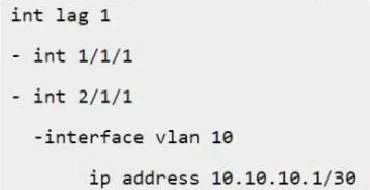
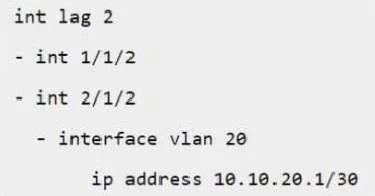
A customer has configured eBGP peering using local AS 65000 with two routers from a CX 6300 VSF stack with the following switch ports: [ports connecting to router - 1 10.10.10.2] [ports connecting…
The correct answer is A. router bgp 65000 address-family ipv4 unicast neighbor 10.10.10.2 fall-over bfd neighbor 10.10.20.2 fall-over bfd. BFD is a fast failure detection protocol. Enabling fall-over bfd under the LAG interface used for BGP peering ensures that BGP will react immediately to a link failure detected by BFD, even if the LAG is still up at the logical level. This prevents blackholing and routing issues.
Question
A customer has configured eBGP peering using local AS 65000 with two routers from a CX 6300 VSF stack with the following switch ports:
[ports connecting to router – 1 10.10.10.2] [ports connecting to router – 2 ip 10.10.20.2] The LAGs are connected to third-party L2 switches, which are used as a transit network for the eBGP routers. To optimize the possible BGP peering issues, the AOS-CX switch is configured with the global settings:
What needs to be done on the AOX-CX switch to enable the bidirectional forwarding with the eBGP peers? A. B. C. D.
Exhibits
Options
- Arouter bgp 65000 address-family ipv4 unicast neighbor 10.10.10.2 fall-over bfd neighbor 10.10.20.2 fall-over bfd
- Brouter bgp 65000 neighbor 10.10.10.2 fall-over bfd neighbor 10.10.20.2 fall-over bfd
- Cint 1/1/1-1/1/2, 2/1/1-2/1/2 fall-over-bfd
- Dinterface lag1-2 fall-over bfd
How the community answered
(54 responses)- A72% (39)
- B4% (2)
- C17% (9)
- D7% (4)
Explanation
BFD is a fast failure detection protocol. Enabling fall-over bfd under the LAG interface used for BGP peering ensures that BGP will react immediately to a link failure detected by BFD, even if the LAG is still up at the logical level. This prevents blackholing and routing issues.
Topics
Community Discussion
No community discussion yet for this question.