
HPE0-S59 · Question #74
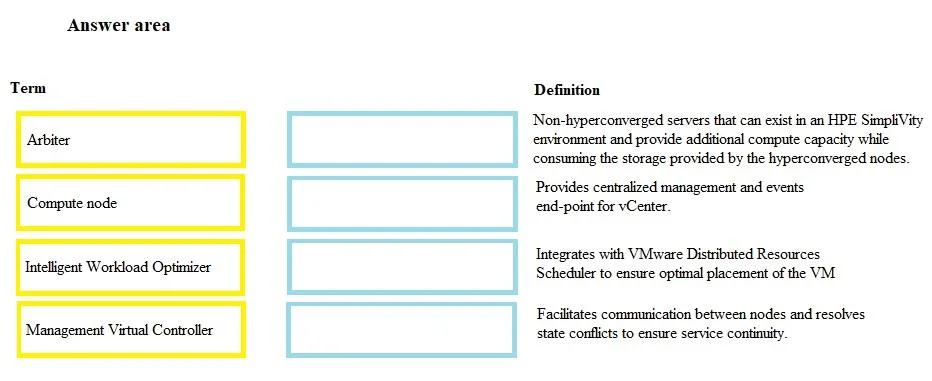
Drag and Drop Question Match HPE SimpliVity term with the definition. Answer:
HPE SimpliVity Term Matching - Explained 1. Arbiter → Facilitates communication between nodes and resolves state conflicts to ensure service continuity The Arbiter is a lightweight software component (runs as a VM, typically off-node) that acts as a tiebreaker in split-brain…
Question
Exhibit
Explanation
HPE SimpliVity Term Matching - Explained
1. Arbiter → Facilitates communication between nodes and resolves state conflicts to ensure service continuity
The Arbiter is a lightweight software component (runs as a VM, typically off-node) that acts as a tiebreaker in split-brain scenarios. When two nodes in a federation disagree about cluster state - e.g., during a network partition - the Arbiter casts the deciding "vote" to determine which node continues serving data. It does not store data itself; it purely mediates.
Common misconception: Confusing the Arbiter with a management tool. It has no UI/management role - it's purely a quorum/consensus service.
2. Compute Node → Non-hyperconverged servers that can provide additional compute while consuming storage from hyperconverged nodes
A Compute Node is a standard server added to a SimpliVity federation without the OmniStack Data Virtualization Card (DVC). It contributes CPU/RAM but has no local SimpliVity storage - it consumes storage from the hyperconverged (OmniStack) nodes in the cluster.
Common misconception: Assuming all nodes in a SimpliVity cluster are hyperconverged. Compute nodes intentionally break that pattern, allowing scale-out of compute independently of storage.
3. Management Virtual Controller (MVC) → Provides centralized management and events end-point for vCenter
The MVC is a VM within the SimpliVity environment that serves as the bridge between HPE SimpliVity and VMware vCenter. It exposes the SimpliVity plugin, collects events, and provides the management API endpoint. Without it, vCenter cannot display SimpliVity data or accept SimpliVity management commands.
Common misconception: Confusing the MVC with the OmniStack Virtual Controller (OVC). The OVC handles data path and storage per host; the MVC handles management plane integration with vCenter specifically.
4. Intelligent Workload Optimizer (IWO) → Integrates with VMware DRS to ensure optimal VM placement
The IWO hooks into VMware's Distributed Resource Scheduler (DRS) and adds SimpliVity-awareness to VM placement decisions. Standard DRS only considers CPU/RAM; IWO extends this so DRS also considers data locality - preferring to run a VM on the host where its data already resides, reducing cross-node traffic and improving performance.
Common misconception: Thinking DRS alone handles optimal placement in SimpliVity. Without IWO, DRS is unaware of storage locality and may migrate VMs away from their data, causing unnecessary network overhead.
Quick Reference Table
| Term | Role | Layer |
|---|---|---|
| Arbiter | Quorum/tiebreaker | Availability/HA |
| Compute Node | Extra CPU/RAM, no local storage | Infrastructure |
| Management Virtual Controller | vCenter integration endpoint | Management plane |
| Intelligent Workload Optimizer | DRS + data locality awareness | Performance optimization |
Topics
Community Discussion
No community discussion yet for this question.