
DP-300 · Question #379
Hotspot Question You plan to deploy an instance of SQL Server on Linux Azure Virtual Machines. The instance will run Microsoft SQL Server 2022 and use the SQL Server IaaS Agent extension for Linux…
This question tests knowledge of SQL Server 2022 on Linux Azure VMs, specifically which Linux distributions are supported by the SQL Server IaaS Agent extension and what key benefits that extension provides.
Question
Exhibit
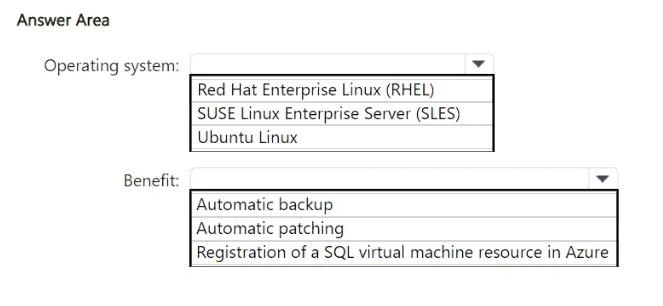
Answer Area
- Operating system:Red Hat Enterprise Linux (RHEL)SUSE Linux Enterprise Server (SLES)Ubuntu Linux
- Benefit:Automatic backupAutomatic patchingRegistration of a SQL virtual machine resource in Azure
Explanation
This question tests knowledge of SQL Server 2022 on Linux Azure VMs, specifically which Linux distributions are supported by the SQL Server IaaS Agent extension and what key benefits that extension provides.
Approach. For SQL Server 2022 on Linux Azure VMs with the SQL Server IaaS Agent extension, the supported Linux operating systems include Red Hat Enterprise Linux (RHEL), SUSE Linux Enterprise Server (SLES), and Ubuntu. Ubuntu (specifically Ubuntu 20.04 LTS or 22.04 LTS) is a commonly tested correct answer as it is fully supported. The SQL Server IaaS Agent extension for Linux provides the benefit of automated backup (integration with Azure Backup) and automated patching - the most highlighted benefit is 'Automated backup' which enables managed backups to Azure Storage. The extension does NOT provide features like full Azure portal management UI as on Windows, but it does enable license management (Azure Hybrid Benefit registration) and storage configuration improvements.
Concept tested. SQL Server IaaS Agent extension for Linux support matrix - knowing which Linux distros are supported (RHEL, SLES, Ubuntu) and understanding that the primary benefit of the Linux IaaS Agent extension is automated backup and Azure Hybrid Benefit license management, as opposed to the broader feature set available on Windows VMs.
Topics
Community Discussion
No community discussion yet for this question.