
DP-100 · Question #507
Drag and Drop Question You are developing a machine learning solution by using the Azure Machine Learning designer. You need to create a web service that applications can use to submit data feature…
The correct answer is Create and run a training pipeline.; Create and run a real-time inference pipeline.; Deploy a service to an inference cluster. To create a real-time prediction web service in Azure Machine Learning designer, one must first train a model, then create and run a real-time inference pipeline, and finally deploy the service to an inference cluster.
Question
Exhibit
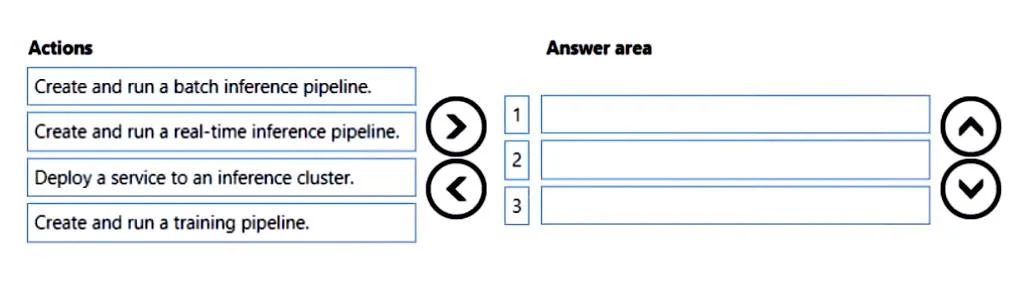
Answer Area
Drag items
Correct arrangement
- Create and run a training pipeline.
- Create and run a real-time inference pipeline.
- Deploy a service to an inference cluster.
Explanation
To create a real-time prediction web service in Azure Machine Learning designer, one must first train a model, then create and run a real-time inference pipeline, and finally deploy the service to an inference cluster.
Approach. The correct approach involves dragging 'Create and run a training pipeline' to slot 1, 'Create and run a real-time inference pipeline' to slot 2, and 'Deploy a service to an inference cluster' to slot 3.
- The scenario requires a web service that applications can use to submit data feature values and retrieve a predicted label, which signifies a real-time prediction scenario.
- Step 1: Create and run a training pipeline. Before any predictions can be made, a machine learning model must be trained on historical data. This is the foundational first step in any machine learning workflow, where the model learns patterns from the data. In Azure ML designer, a training pipeline defines this process.
- Step 2: Create and run a real-time inference pipeline. After a model is successfully trained, it needs to be prepared for deployment as a service. For real-time predictions where an application submits individual data points, a real-time inference pipeline is required. In Azure ML designer, you typically convert a trained pipeline into a real-time inference pipeline, which includes the necessary web service input and output components. Running this pipeline validates its functionality before deployment.
- Step 3: Deploy a service to an inference cluster. Once the real-time inference pipeline is created and validated, it must be deployed as a web service to make it accessible to external applications. This deployment typically targets an inference cluster, such as Azure Kubernetes Service (AKS) or Azure Container Instances (ACI), which provides the compute resources for the web service endpoint.
Common mistakes.
- common_mistake. - Choosing 'Create and run a batch inference pipeline': The question specifically asks for a 'web service that applications can use to submit data feature values and retrieve a predicted label.' This describes a real-time prediction scenario, not a batch prediction scenario. Batch inference is used for processing large volumes of data offline or on a schedule, not for interactive, on-demand predictions via a web service API.
- Incorrect sequencing: Any deviation from the established sequence would lead to an incorrect solution.
- Deploying a service (Step 3) before creating and running the inference pipeline (Step 2) or training the model (Step 1) is impossible, as there would be no service or model to deploy.
- Creating an inference pipeline (Step 2) before training the model (Step 1) is incorrect because an inference pipeline requires a trained model to perform predictions.
- Swapping the order of 'Create and run a real-time inference pipeline' and 'Deploy a service to an inference cluster' would also be incorrect because the inference pipeline must be created and validated (run) before it can be successfully deployed as a robust web service.
Concept tested. This question tests the understanding of the machine learning lifecycle stages, specifically model training, the creation and validation of real-time inference pipelines, and the subsequent deployment of these pipelines as web services within the Azure Machine Learning designer. It also tests the ability to differentiate between real-time and batch inference scenarios.
Topics
Community Discussion
No community discussion yet for this question.