
DP-100 · Question #506
Drag and Drop Question You have an Azure Machine Learning workspace that contains a training cluster and an inference cluster. You plan to create a classification model by using the Azure Machine…
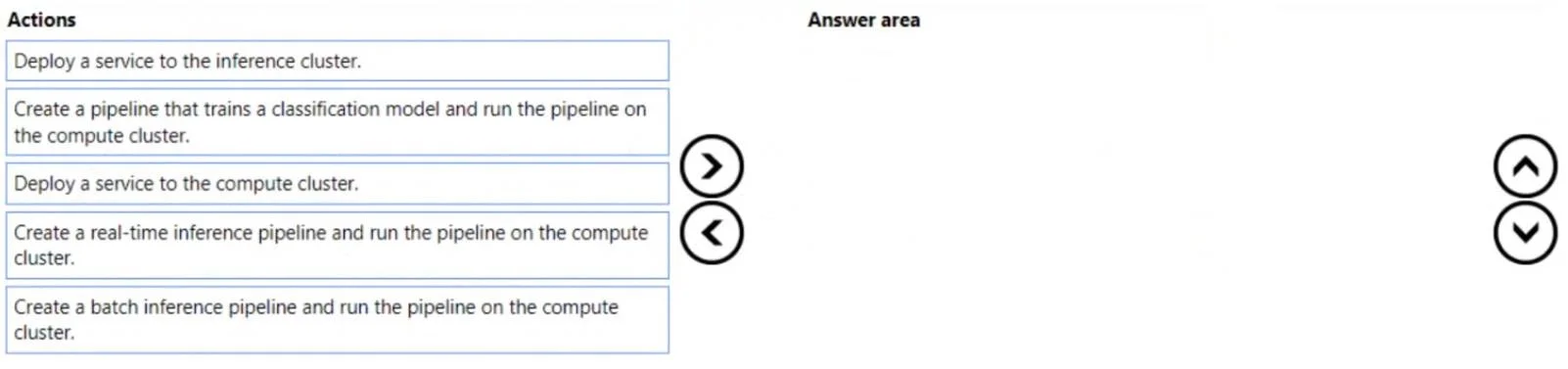
The correct answer is Create a pipeline that trains a classification model and run the pipeline on the compute cluster.; Create a real-time inference pipeline and run the pipeline on the compute cluster.; Deploy a service to the inference cluster. To enable real-time predictions via HTTP requests, first train the model, then create a real-time inference pipeline from the trained model, and finally deploy this pipeline as a service to the dedicated inference cluster.
Question
Exhibit
Answer Area
Drag items
Correct arrangement
- Create a pipeline that trains a classification model and run the pipeline on the compute cluster.
- Create a real-time inference pipeline and run the pipeline on the compute cluster.
- Deploy a service to the inference cluster.
Explanation
To enable real-time predictions via HTTP requests, first train the model, then create a real-time inference pipeline from the trained model, and finally deploy this pipeline as a service to the dedicated inference cluster.
Approach. The core requirement is to enable client applications to submit data via HTTP requests and receive real-time predictions. This dictates a real-time inference solution. The logical sequence of operations in Azure Machine Learning to achieve this is:
- Train the model: Before any inference can be performed, a model must be trained. The action 'Create a pipeline that trains a classification model and run the pipeline on the compute cluster.' directly addresses this. The 'compute cluster' here refers to the training compute resource, which in the scenario is the 'training cluster'.
- Prepare for real-time inference: Once a model is trained, it needs to be packaged and configured for inference. For real-time predictions via HTTP, a real-time inference pipeline is essential. The action 'Create a real-time inference pipeline and run the pipeline on the compute cluster.' sets up the model for scoring in real-time. In the Azure Machine Learning designer, after training, you typically create an inference pipeline from the trained model. While the final deployment is to an inference cluster, the 'running' part of creating the pipeline might involve testing or defining the graph on a general compute resource.
- Deploy the inference service: Finally, for client applications to access the model via HTTP, the real-time inference pipeline needs to be deployed as a service to an endpoint. The scenario explicitly mentions an 'inference cluster'. Therefore, 'Deploy a service to the inference cluster.' is the correct final step to make the model available as a web service.
Common mistakes.
- common_mistake. - Deploy a service to the compute cluster: While a compute cluster (like a training cluster) can be used for training, it's not typically the target for deploying a production-grade inference service. Dedicated inference clusters (like Azure Kubernetes Service or Azure Container Instances) are used for deploying services for scalability and reliability. Deploying to the 'inference cluster' is the correct choice.
- Create a batch inference pipeline and run the pipeline on the compute cluster: This is incorrect because the requirement is for real-time predictions via HTTP requests, not batch processing. Batch inference is used for processing large volumes of data offline, not for immediate responses to HTTP requests.
- Incorrect order: Swapping the order of training, creating the inference pipeline, or deploying would lead to a non-functional or illogical workflow. For example, deploying before creating the inference pipeline makes no sense, and creating an inference pipeline before training a model is impossible.
Concept tested. Azure Machine Learning workflow for model training and real-time inference deployment, understanding the purpose of training clusters, inference clusters, training pipelines, and real-time inference pipelines.
Reference. null
Topics
Community Discussion
No community discussion yet for this question.