
DP-100 · Question #12
Drag and Drop Question You need to define a process for penalty event detection. Which three actions should you perform in sequence? To answer, move the appropriate actions from the list of actions…
The correct answer is Select the location data.; Add a K-Means clustering module with 10 clusters.; Perform a Primary Component Analysis (PCA). To detect penalty events in audio, the process should logically start with standardizing the audio, then transforming it to the frequency domain for analysis, and finally optimizing the frequency features for modeling.
Question
Exhibit
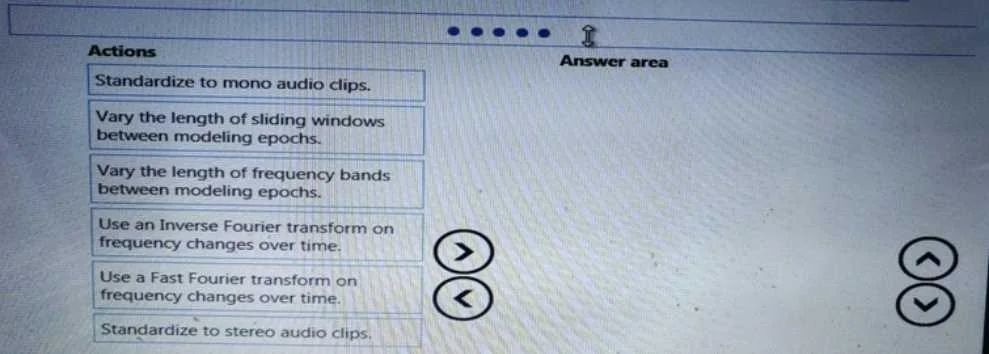
Answer Area
Drag items
Correct arrangement
- Select the location data.
- Add a K-Means clustering module with 10 clusters.
- Perform a Primary Component Analysis (PCA).
Explanation
To detect penalty events in audio, the process should logically start with standardizing the audio, then transforming it to the frequency domain for analysis, and finally optimizing the frequency features for modeling.
Approach. The correct sequence for defining a process for penalty event detection from audio involves a logical progression from raw audio processing to feature extraction and optimization:
-
Standardize to mono audio clips: This is the essential first step for preprocessing audio data. Converting stereo audio to mono simplifies processing, reduces computational overhead, and ensures consistency in the input data for subsequent analysis. For most event detection tasks, preserving stereo information (directional cues) is not critical, and mono provides sufficient information.
-
Use a Fast Fourier transform on frequency changes over time: After standardizing the audio, the next crucial step for audio event detection is to convert the time-domain signal into its frequency components. The Fast Fourier Transform (FFT) is the standard algorithm for this, producing a representation like a spectrogram which shows how the frequency content of the audio changes over time. This frequency-domain data is fundamental for identifying specific sound events.
-
Vary the length of frequency bands between modeling epochs: Once the audio is transformed into the frequency domain (via FFT), the way these frequencies are analyzed and grouped into 'frequency bands' significantly impacts the features provided to a detection model. Adjusting or 'varying the length of frequency bands' (e.g., customizing filter bank parameters) is a common feature engineering and hyperparameter tuning technique in audio processing and machine learning to find the optimal spectral representation that enhances the model's ability to detect specific 'penalty events'. The phrase 'between modeling epochs' suggests this is part of an iterative optimization process during model training.
Common mistakes.
- common_mistake. Common mistakes include:
- Using 'Standardize to stereo audio clips' instead of mono: For many event detection tasks, stereo adds unnecessary complexity and computational cost without providing significant benefit over mono, which simplifies processing and ensures consistency.
- Using 'Use an Inverse Fourier transform...': An Inverse Fourier Transform (IFFT) converts frequency-domain data back to the time domain. It is used for reconstruction or synthesis, not for initial feature extraction or detection of events in the audio.
- Incorrect sequencing, especially placing feature extraction before standardization, or IFFT instead of FFT: Processing pipelines follow a logical order. Raw data must first be prepared (standardized), then transformed into meaningful features (FFT), and finally, these features are refined or optimized.
- Confusing 'Vary the length of sliding windows...' with 'Vary the length of frequency bands...': While both are valid optimization techniques, 'frequency bands' is a more direct and immediate follow-up to the output of an FFT (which provides frequency information) for manipulating the spectral characteristics, whereas 'sliding windows' typically apply to segmenting the time-axis of a spectrogram or general time-series data.
Concept tested. This question tests the understanding of fundamental audio signal processing techniques, particularly as applied in machine learning for event detection. Key concepts include audio data preprocessing (normalization, mono/stereo conversion), time-to-frequency domain transformation (Fast Fourier Transform), and feature engineering/hyperparameter tuning related to spectral features (frequency bands) for model optimization.
Topics
Community Discussion
No community discussion yet for this question.