
DP-100 · Question #11
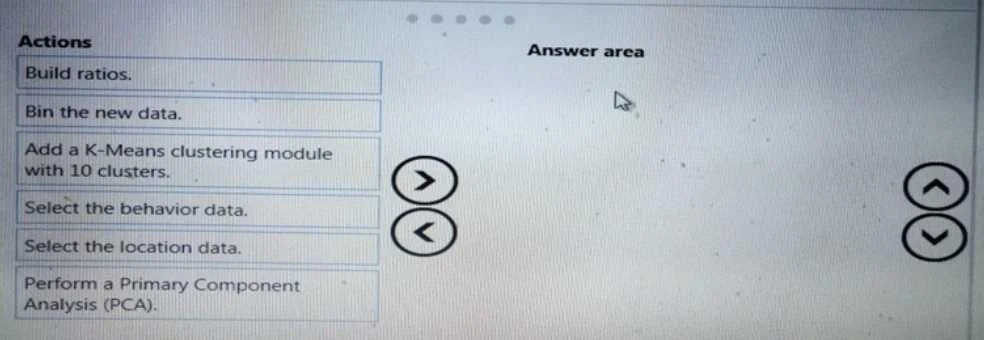
Drag and Drop Question You need to modify the inputs for the global penalty event model to address the bias and variance issue. Which three actions should you perform in sequence? To answer, move…
The correct answer is Select the location data.; Add a K-Means clustering module with 10 clusters.; Perform a Primary Component Analysis (PCA). The correct sequence of actions involves selecting the relevant data, applying K-Means clustering to identify patterns or create features, and then performing Primary Component Analysis (PCA) for dimensionality reduction, collectively addressing bias and variance in a machine…
Question
Exhibit
Answer Area
Drag items
Correct arrangement
- Select the location data.
- Add a K-Means clustering module with 10 clusters.
- Perform a Primary Component Analysis (PCA).
Explanation
The correct sequence of actions involves selecting the relevant data, applying K-Means clustering to identify patterns or create features, and then performing Primary Component Analysis (PCA) for dimensionality reduction, collectively addressing bias and variance in a machine learning model.
Approach. The correct interaction is to drag the following three actions, in this specific order, into the 'Answer area':
-
Select the behavior data. - This is the essential first step. Before any data processing or model modification can occur, the specific dataset or features to be operated upon must be selected or identified as the input. The problem asks to modify inputs for a model, so selecting the relevant data is a prerequisite.
-
Add a K-Means clustering module with 10 clusters. - K-Means clustering is an unsupervised learning technique that groups data points into 'k' clusters based on similarity. For addressing bias and variance, clustering can help in several ways: it can reveal underlying patterns or segments in the data that might not be obvious, which can lead to better feature engineering (e.g., using cluster IDs as new features) and reduce bias by allowing the model to learn more nuanced relationships for different data segments. By understanding the inherent structure, the model can make more informed decisions.
-
Perform a Primary Component Analysis (PCA). - PCA is a powerful dimensionality reduction technique. It transforms a set of possibly correlated variables into a smaller set of uncorrelated variables (principal components). This process directly addresses the issue of variance by reducing the number of features, mitigating overfitting, and handling multicollinearity. By focusing on the most significant components of the data, PCA can help stabilize the model and improve its generalization ability. The sequence is logical: first, identify the data; second, enhance its representation or understanding through clustering; and third, reduce its complexity and dimensionality to prevent overfitting and improve robustness.
Common mistakes.
- common_mistake. Common mistakes include selecting actions that are less directly impactful for simultaneously addressing both bias and variance, or choosing an incorrect sequence.
- 'Build ratios.' and 'Bin the new data.': While these are valid feature engineering techniques, they are generally less comprehensive or direct in addressing both bias and variance compared to clustering and PCA in tandem. Building ratios can introduce new features, which might reduce bias, and binning can reduce noise, which might affect variance, but they are not as fundamentally transformative as K-Means for pattern discovery or PCA for dimensionality reduction.
- 'Select the location data.': The problem specifically implies focusing on 'behavior data' as the primary input for the 'global penalty event model.' Selecting 'location data' would be incorrect unless the scenario explicitly indicated it as the primary or additional necessary input, which it does not. The provided solution also confirms 'Select the behavior data' as the correct choice for the initial data selection.
Concept tested. Machine learning model improvement techniques, specifically focusing on feature engineering, dimensionality reduction, and methods to mitigate bias and variance. This includes understanding the applications of K-Means clustering and Primary Component Analysis (PCA) in data preparation and model optimization.
Topics
Community Discussion
No community discussion yet for this question.