
CNX-001 · Question #90
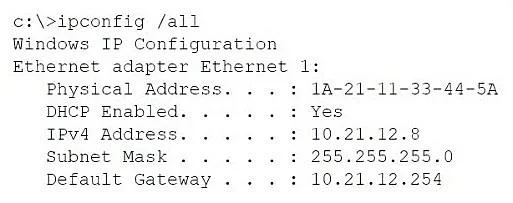
A network administrator is troubleshooting a user's workstation that is unable to connect to the company network. The results of commands the administrator runs on the workstation are shown below: A…
The correct answer is B. IP address conflict. The workstation cannot connect because another device on the network shares the same IP address, causing the router to receive conflicting ARP entries and deliver packets unpredictably.
Question
A network administrator is troubleshooting a user's workstation that is unable to connect to the company network. The results of commands the administrator runs on the workstation are shown below:
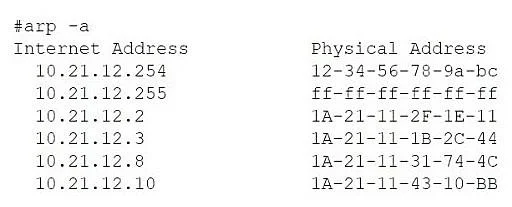
A router on the same network shows the following output:
Which of the following is the most likely cause of the issues?
Exhibits
Options
- AAsynchronous routing
- BIP address conflict
- CDHCP server down
- DBroadcast storm
How the community answered
(27 responses)- A15% (4)
- B74% (20)
- C4% (1)
- D7% (2)
Why each option
The workstation cannot connect because another device on the network shares the same IP address, causing the router to receive conflicting ARP entries and deliver packets unpredictably.
Asynchronous routing describes a condition where traffic flows through different paths in each direction, which is a routing topology issue affecting traffic flows network-wide, not a single workstation's ability to obtain or use an IP address.
An IP address conflict occurs when two devices are assigned the same IP, causing the router's ARP table to contain duplicate or alternating MAC address entries for that IP. The affected workstation loses reliable connectivity because replies may be delivered to the other conflicting device instead. This matches the scenario where both the workstation output and the router's ARP or interface output would reveal duplicate IP-to-MAC mappings.
If the DHCP server were down, the workstation would fail to lease any address and would fall back to an APIPA address in the 169.254.0.0/16 range, and all DHCP-dependent clients on the segment would be affected - not just one workstation.
A broadcast storm is caused by switching loops or misconfigurations that flood the network with broadcast frames, degrading connectivity for all devices on the segment simultaneously, not selectively for a single workstation.
Concept tested: IP address conflict detection and ARP troubleshooting
Source: https://learn.microsoft.com/en-us/troubleshoot/windows-client/networking/ip-address-conflict
Topics
Community Discussion
No community discussion yet for this question.