
CAS-003 · Question #472
A security engineer is analyzing an application during a security assessment to ensure it is configured to protect against common threats. Given the output below: Which of the following tools did…
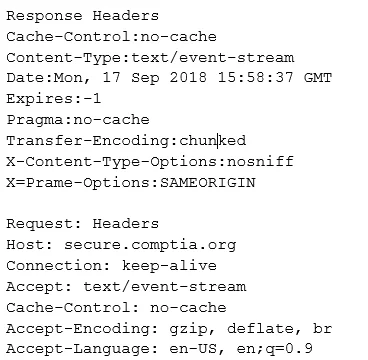
The correct answer is C. HTTP interceptor. An HTTP interceptor (such as Burp Suite or OWASP ZAP) captures and displays raw HTTP request and response data, including headers, cookies, status codes, and body content. During a security assessment of a web application, the output of an HTTP interceptor shows the exact…
Question
A security engineer is analyzing an application during a security assessment to ensure it is configured to protect against common threats. Given the output below:
Which of the following tools did the security engineer MOST likely use to generate this output?
Exhibit
Options
- AApplication fingerprinter
- BFuzzer
- CHTTP interceptor
- DVulnerability scanner
How the community answered
(25 responses)- B4% (1)
- C88% (22)
- D8% (2)
Explanation
An HTTP interceptor (such as Burp Suite or OWASP ZAP) captures and displays raw HTTP request and response data, including headers, cookies, status codes, and body content. During a security assessment of a web application, the output of an HTTP interceptor shows the exact request/response exchange, which allows the engineer to verify security headers (e.g., Content-Security-Policy, X-Frame-Options, HSTS), cookie flags (Secure, HttpOnly), and other configuration elements that protect against common threats. An application fingerprinter (A) identifies software versions and technologies but does not show full request/response detail. A fuzzer (B) sends malformed inputs and reports crashes or errors, not configuration details. A vulnerability scanner (D) provides automated vulnerability findings, not raw HTTP traffic output.
Topics
Community Discussion
No community discussion yet for this question.