
AZ-800 · Question #219
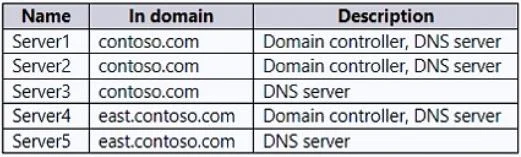
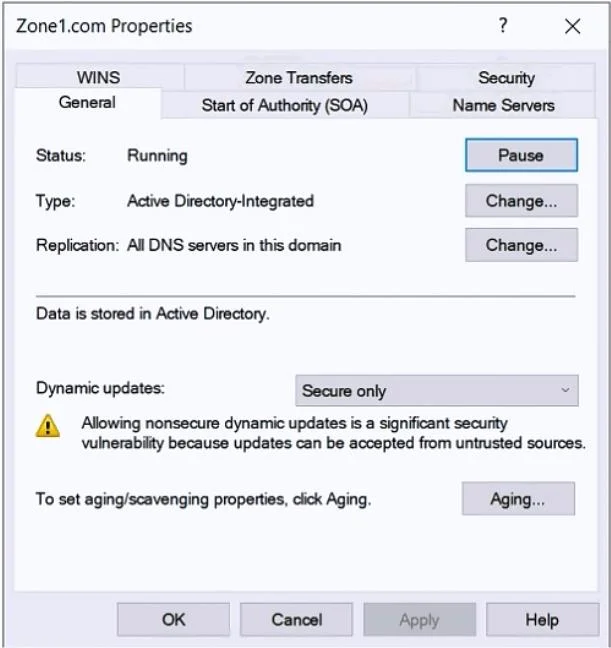
Your network contains an Active Directory Domain Services (AD DS) forest. The forest contains the servers shown in the following table. On Server1, you create a DNS zone named Zone1.com as shown in…
The correct answer is A. Server2 only. Option A is correct because Zone1.com is configured as an Active Directory-integrated zone with a replication scope of "To all DNS servers in this domain" - and Server2 is the only other DNS server that resides in the same AD DS domain as Server1. AD-integrated zones replicate…
Question
Your network contains an Active Directory Domain Services (AD DS) forest. The forest contains the servers shown in the following table. On Server1, you create a DNS zone named Zone1.com as shown in the following exhibit. To which DNS servers is Zone1.com replicated?
Exhibits
Options
- AServer2 only
- BServer2 and Server3 only
- CServer2 and Server4 only
- DServer2, Server3, and Server4 only
- EServer2, Server3, Server4, and Server5
How the community answered
(40 responses)- A73% (29)
- B3% (1)
- C5% (2)
- D13% (5)
- E8% (3)
Explanation
Option A is correct because Zone1.com is configured as an Active Directory-integrated zone with a replication scope of "To all DNS servers in this domain" - and Server2 is the only other DNS server that resides in the same AD DS domain as Server1. AD-integrated zones replicate through AD replication, not traditional zone transfers, so only servers participating in the correct AD partition receive the zone data.
Why the distractors are wrong:
- B & D (Server3): Server3 is a DNS server in a different domain within the forest. The replication scope "this domain" excludes cross-domain servers unless the scope is set to "entire forest."
- C & D (Server4): Server4 is a DNS server that is not Active Directory-integrated (e.g., a standalone or non-Windows DNS server), so it cannot receive AD replication data.
- E (Server5): Server5 does not run the DNS Server role at all, so it is never a replication target regardless of scope.
Memory tip: Think of AD-integrated DNS replication scopes as narrowing rings - Forest (all AD DNS servers everywhere) → Domain (only your domain's AD DNS servers) → Custom partition (specific servers you designate). When the scope is "this domain," only same-domain AD DNS servers are in that ring.
Topics
Community Discussion
No community discussion yet for this question.