
AZ-305 · Question #392
Hotspot Question You have an Azure subscription that contains an Azure Data Lake Storage Gen2 account named storage1. Storage1 contains semi-structured sales data in Parquet files. You ingest…
Microsoft Fabric Data Integration - Hotspot Explanation Correct Answers | Dropdown | Correct Answer | |---|---| | Reference the Dataverse data | A OneLake shortcut | | Consume the transformed data from Power BI | Direct Lake | --- Dropdown 1: Reference the Dataverse data -> A…
Question
Exhibit
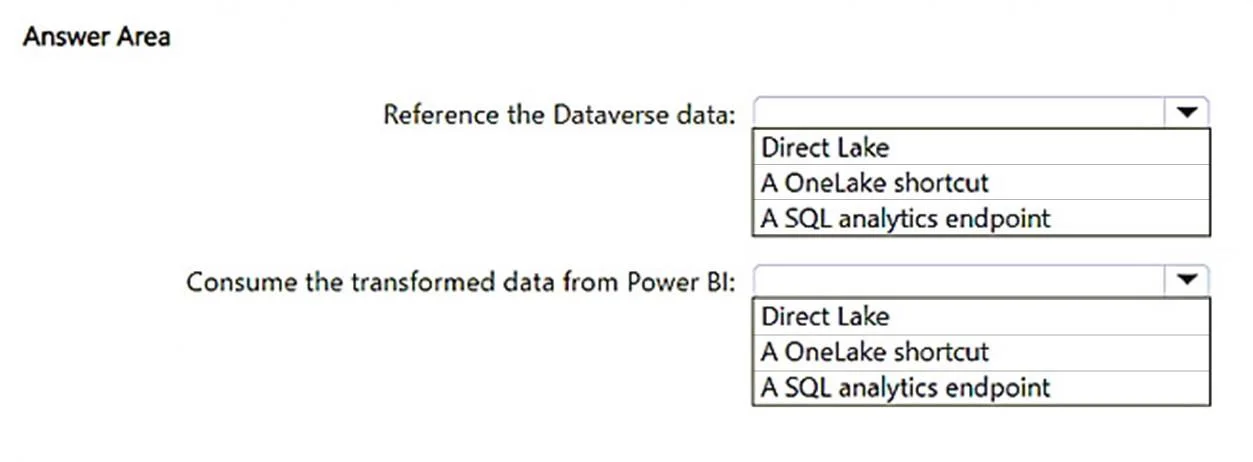
Answer Area
- Reference the Dataverse data:Direct LakeA OneLake shortcutA SQL analytics endpoint
- Consume the transformed data from Power BI:Direct LakeA OneLake shortcutA SQL analytics endpoint
Explanation
Microsoft Fabric Data Integration - Hotspot Explanation
Correct Answers
| Dropdown | Correct Answer |
|---|---|
| Reference the Dataverse data | A OneLake shortcut |
| Consume the transformed data from Power BI | Direct Lake |
Dropdown 1: Reference the Dataverse data -> A OneLake shortcut
Why it's correct: OneLake shortcuts create virtual references to external data sources - including Dataverse - without physically copying or moving the data into Fabric. This directly satisfies the "minimize data duplication" requirement. A shortcut points to Dataverse data in-place, so it appears within Fabric as if it's local, but no duplicate exists.
Why the alternatives are wrong:
- Direct Lake - This is a Power BI query mode that reads Delta/Parquet files from OneLake at query time. It has nothing to do with referencing external sources like Dataverse; it's a consumption pattern, not a referencing mechanism.
- SQL analytics endpoint - This is a read-only, auto-generated T-SQL interface over a Lakehouse. It allows querying data already in OneLake; it doesn't let you reference or integrate external Dataverse data.
Dropdown 2: Consume the transformed data from Power BI -> Direct Lake
Why it's correct: Direct Lake is a Fabric-native Power BI storage mode that reads Delta tables directly from OneLake - no data import, no DirectQuery overhead. It delivers import-mode performance (fast, in-memory analytics) while keeping data current from OneLake. This directly satisfies "minimize how long it takes to generate reports."
Why the alternatives are wrong:
- A OneLake shortcut - Shortcuts are a data referencing/integration tool, not a Power BI query mode. Power BI doesn't use shortcuts as a consumption strategy for performance optimization.
- A SQL analytics endpoint - Power BI can connect to the SQL analytics endpoint via DirectQuery, but DirectQuery sends live T-SQL queries on each interaction, making it significantly slower than Direct Lake for report generation. It does not minimize report time.
Key Concept Summary
| Concept | Purpose |
|---|---|
| OneLake shortcut | Virtual reference to external data (no copy) - solves duplication |
| Direct Lake | Fast Power BI query mode over OneLake Delta tables - solves report speed |
| SQL analytics endpoint | Read-only T-SQL interface over Lakehouse data - for SQL tooling, not optimized BI |
Topics
Community Discussion
No community discussion yet for this question.