
AZ-305 · Question #215
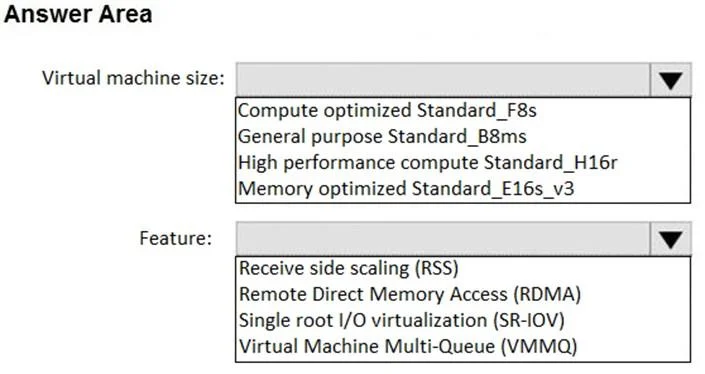
You need to recommend a solution that meets the following requirements: - Minimizes the use of the virtual machine processors to transfer data - Minimizes network latency Which virtual machine size…
The correct answer is C. High performance compute Standard_H16r F. Remote Direct Memory Access (RDMA). Standard_H16r is Azure's High Performance Compute VM with the r suffix explicitly indicating built-in RDMA support. RDMA (Remote Direct Memory Access) transfers data directly between machines' memory, completely bypassing the CPU and OS networking stack - which simultaneously…
Question
Exhibits
Options
- ACompute optimized Standard_F8s
- BGeneral purpose Standard_B8ms
- CHigh performance compute Standard_H16r
- DMemory optimized Standard_E16s_v3
- EReceive side scaling (RSS)
- FRemote Direct Memory Access (RDMA)
- GSingle root I/O virtualization (SR-IOV)
- HVirtual Machine Multi-Queue (VMMQ)
How the community answered
(60 responses)- A2% (1)
- B3% (2)
- C73% (44)
- D13% (8)
- E7% (4)
- G2% (1)
Explanation
Standard_H16r is Azure's High Performance Compute VM with the r suffix explicitly indicating built-in RDMA support. RDMA (Remote Direct Memory Access) transfers data directly between machines' memory, completely bypassing the CPU and OS networking stack - which simultaneously minimizes processor usage and network latency, satisfying both requirements.
Why the distractors are wrong:
- A (F8s) and D (E16s_v3): Compute/memory-optimized VMs lack RDMA support; their network is standard.
- B (B8ms): Burstable general-purpose VMs are designed for variable workloads, not low-latency networking.
- E (RSS): Receive Side Scaling distributes network interrupts across multiple CPU cores - it actually increases CPU involvement, not decreases it.
- G (SR-IOV): Enables Accelerated Networking (reduces latency via hardware passthrough), but still routes through the CPU; it doesn't achieve the zero-CPU-copy that RDMA does.
- H (VMMQ): Like RSS, it uses multi-queue processing across CPUs - more CPU involvement, not less.
Memory tip: Think "RDMA = RAM-to-RAM, no CPU in between." The r in H16r stands for RDMA - whenever an exam question says minimize CPU for data transfer, the answer is always RDMA + an HPC VM that supports it.
Topics
Community Discussion
No community discussion yet for this question.