
AZ-305 · Question #214
Hotspot Question You have five .NET Core applications that run on 10 Azure virtual machines in the same subscription. You need to recommend a solution to ensure that the applications can…
The correct answer is To provision the Azure AD identity:: Create a user-assigned Managed Service Identity; To authenticate request a token by using:: An Azure Instance Metadata Service Identity. This question tests knowledge of Azure AD Managed Identities and how to assign them to Azure Virtual Machines so that multiple applications can share the same identity while being restricted to specific VMs.
Question
Exhibit
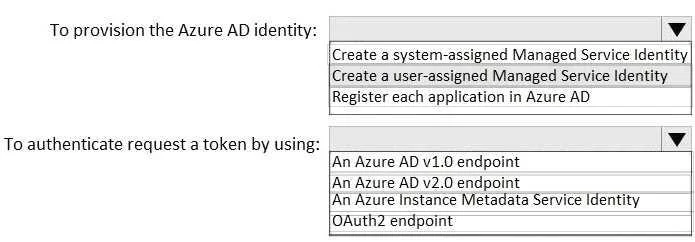
Answer Area
- To provision the Azure AD identity:Create a user-assigned Managed Service IdentityCreate a system-assigned Managed Service IdentityCreate a user-assigned Managed Service IdentityRegister each application in Azure AD
- To authenticate request a token by using:An Azure Instance Metadata Service IdentityAn Azure AD v1.0 endpointAn Azure AD v2.0 endpointAn Azure Instance Metadata Service IdentityOAuth2 endpoint
Explanation
This question tests knowledge of Azure AD Managed Identities and how to assign them to Azure Virtual Machines so that multiple applications can share the same identity while being restricted to specific VMs.
Approach. The correct approach is to use a User-Assigned Managed Identity. A User-Assigned Managed Identity is created as a standalone Azure resource and can be assigned to multiple VMs (all 10 in this case), allowing all five .NET Core applications running on those VMs to authenticate using the same Azure AD identity. This satisfies the constraint that applications can only authenticate when running on those specific VMs (since the managed identity token is only accessible from the VM's instance metadata endpoint) and minimizes administrative effort because there are no credentials to manage, rotate, or store. You would: (1) Create one User-Assigned Managed Identity, and (2) Assign that identity to all 10 Virtual Machines - rather than creating 10 separate System-Assigned Managed Identities (one per VM) which would require managing 10 different identities and granting permissions 10 times.
Concept tested. Azure AD Managed Identities - specifically the difference between System-Assigned Managed Identity (tied to a single resource lifecycle) and User-Assigned Managed Identity (a standalone resource that can be shared across multiple Azure resources), and how they enable passwordless authentication for applications running on Azure VMs.
Reference. https://learn.microsoft.com/en-us/azure/active-directory/managed-identities-azure-resources/overview
Topics
Community Discussion
No community discussion yet for this question.