
AZ-104 · Question #711
Hotspot Question You have an Azure subscription that contains the virtual networks shown in the following table. Each virtual network has 50 connected virtual machines. You need to implement Azure…
This question tests your understanding of Azure Bastion SKU tiers, subnet sizing, and cross-VNet support via VNet peering or IP-based connections. You must configure Bastion to support host scaling, file transfer, multi-VNet support, and minimize subnet address space.
Question
Exhibit
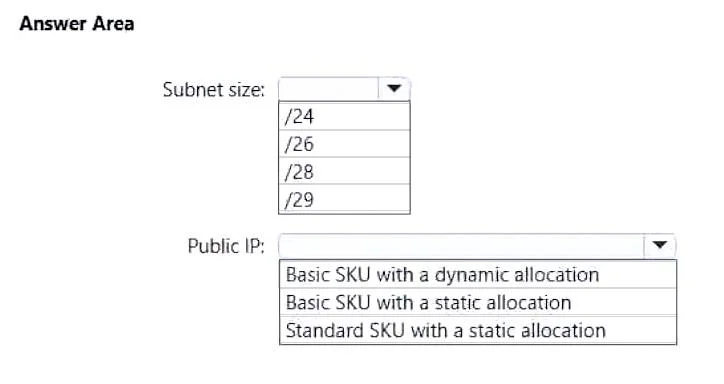
Answer Area
- Subnet size:/24/26/28/29
- Public IP:Basic SKU with a dynamic allocationBasic SKU with a static allocationStandard SKU with a static allocation
Explanation
This question tests your understanding of Azure Bastion SKU tiers, subnet sizing, and cross-VNet support via VNet peering or IP-based connections. You must configure Bastion to support host scaling, file transfer, multi-VNet support, and minimize subnet address space.
Approach. The correct SKU is Standard (or Premium), because the Basic SKU does not support host scaling or file upload/download (which require the Standard tier or higher). To support virtual machines on both VNet1 and VNet2, you would use IP-based connections (available in Standard SKU), which allows Bastion deployed in one VNet to connect to VMs in peered or non-peered VNets by specifying the target VM's private IP address - this avoids deploying a separate Bastion in each VNet. For the AzureBastionSubnet size, to minimize addresses while supporting host scaling, the minimum recommended subnet size is /26 (64 addresses), which provides enough IPs for scaling Bastion instances; a /27 (32 addresses) only supports up to 2 instances and limits scaling, so /26 is the correct minimum to support scaling. Therefore: SKU = Standard, AzureBastionSubnet = /26.
Concept tested. Azure Bastion SKU tiers (Basic vs Standard), AzureBastionSubnet sizing requirements for host scaling, and cross-VNet connectivity using IP-based connections in the Standard SKU
Reference. https://learn.microsoft.com/en-us/azure/bastion/configuration-settings and https://learn.microsoft.com/en-us/azure/bastion/bastion-overview#skus
Topics
Community Discussion
No community discussion yet for this question.