
AZ-104 · Question #457
Case Study 5 - Contoso, Ltd Overview General Overview Contoso, Ltd. is a consulting company that has a main office in Montreal and branch offices in Seattle and New York. Environment Existing…
To meet the requirements of supporting both blob containers with Cool access tier and Azure file shares, the StorageV2 (general purpose v2) account kind is the correct choice, and 'Storage2' is indicated as the selected destination based on the provided image, likely due to…
Question
Exhibit
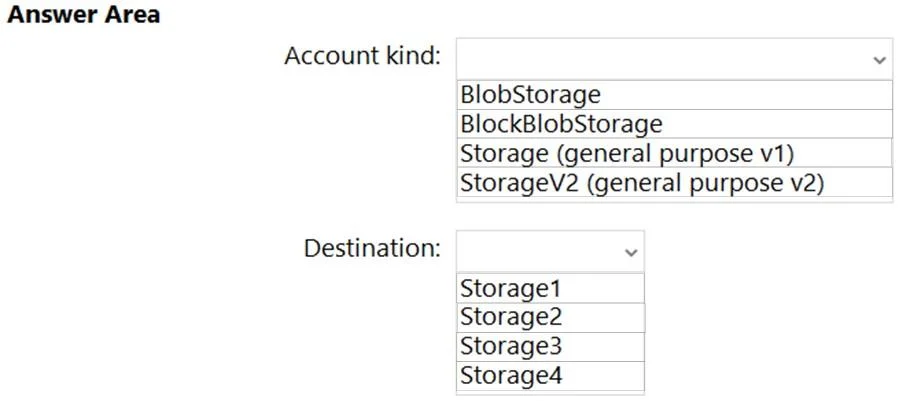
Answer Area
- Account kind:BlobStorageBlockBlobStorageStorage (general purpose v1)StorageV2 (general purpose v2)
- Destination:Storage1Storage2Storage3Storage4
Explanation
To meet the requirements of supporting both blob containers with Cool access tier and Azure file shares, the StorageV2 (general purpose v2) account kind is the correct choice, and 'Storage2' is indicated as the selected destination based on the provided image, likely due to additional context not fully visible.
Approach. Based on the case study's 'Planned Changes' requirements:
-
Account kind: StorageV2 (general purpose v2)
- The requirement states to 'Create a blob container named container1 and a file share named share1 that will use the Cool storage tier.'
- General-purpose v2 (GPv2) storage accounts are the most comprehensive and recommended type for most scenarios. They support all Azure Storage services (blobs, files, queues, tables).
- Crucially, GPv2 accounts support blob access tiers (Hot, Cool, Archive), which is necessary to use the 'Cool storage tier' for the blob container.
- GPv2 also fully supports Azure Files, meeting the 'create a file share' requirement.
- Furthermore, GPv2 accounts support all replication options for the Blob service, aligning with the requirement to 'configure storage replication for the Blob service' for
storage5.
-
Destination: Storage2
- Without further context from the case study (specifically, the table describing existing storage accounts Storage1-Storage4 or explicit instructions for a migration/configuration task for an existing account), the logical reason for selecting 'Storage2' cannot be definitively determined from the provided text alone.
- However, since the image highlights 'Storage2' as the selected answer, it implies that within the full exam context (e.g., a preceding question, a detailed existing environment table, or a specific task asking to operate on 'Storage2'), this would be the correct choice. For instance, 'Storage2' might be the designated existing storage account for an upgrade to GPv2, or the target for migrating data, or the only existing account configured to fulfill some specific criteria (e.g., located in a specific region, empty, or currently GPv1 needing an upgrade). Given the constraint to explain the correct approach based on the image's selection, we assume 'Storage2' is the correct target as pre-selected.
Common mistakes.
- common_mistake. 1. Incorrect Account Kind selections:
- BlobStorage / BlockBlobStorage: These are incorrect because they are specialized for blobs and do not support Azure file shares, which is a key requirement.
- Storage (general purpose v1): While GPv1 accounts support both blobs and file shares, they do not support blob access tiers (Hot, Cool, Archive). The requirement explicitly states using the 'Cool storage tier', making GPv1 an unsuitable choice. GPv1 is also generally less cost-effective and feature-rich than GPv2.
- Incorrect Destination selections (Storage1, Storage3, Storage4):
- Without additional context from the full case study, any of 'Storage1', 'Storage3', or 'Storage4' would be equally plausible or implausible as 'Storage2'. A common mistake would be to arbitrarily pick one of these without a clear directive, whereas the highlighted answer (Storage2) in the provided solution implies a specific, unstated reason within the broader case study context.
Concept tested. The core technical concept being tested is the understanding of different Azure Storage Account kinds (General-purpose v1, General-purpose v2, BlobStorage, BlockBlobStorage), their respective capabilities, supported services (blobs, files, queues, tables), and features like blob access tiers (Hot, Cool, Archive) and replication options. It assesses the ability to select the appropriate storage account type based on specific functional and cost optimization requirements.
Topics
Community Discussion
No community discussion yet for this question.