
AZ-104 · Question #113
Hotspot Question You plan to deploy five virtual machines to a virtual network subnet. Each virtual machine will have a public IP address and a private IP address. Each virtual machine requires the…
This question tests your understanding of Azure networking components - specifically how Network Interfaces (NICs) and Network Security Groups (NSGs) are used and how they can be shared or must be dedicated per resource.
Question
Exhibits
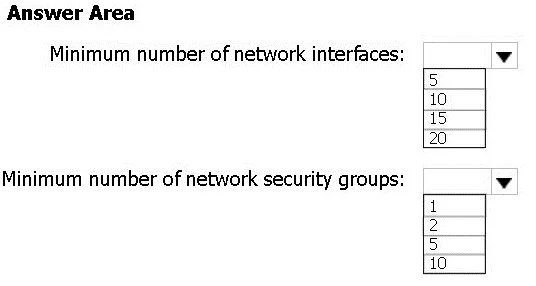
Answer Area
- Minimum number of network interfaces:5101520
- Minimum number of network security groups:12510
Explanation
This question tests your understanding of Azure networking components - specifically how Network Interfaces (NICs) and Network Security Groups (NSGs) are used and how they can be shared or must be dedicated per resource.
Approach. Each virtual machine requires exactly one Network Interface (NIC) to connect to the virtual network, so 5 VMs require a minimum of 5 NICs. However, a single Network Security Group (NSG) can be associated with a subnet and will apply the same inbound and outbound rules to all VMs within that subnet - meaning only 1 NSG is needed. Since all five VMs require the same security rules, associating one NSG with the subnet (rather than each individual NIC) satisfies the requirement with the minimum number of NSGs. Therefore, the correct answer is: 5 Network Interfaces and 1 Network Security Group.
Concept tested. Azure Network Interfaces (NICs) are required on a per-VM basis - each VM must have at least one NIC to participate in a virtual network. Network Security Groups (NSGs), however, can be applied at either the subnet level or the individual NIC level. When applied at the subnet level, a single NSG governs traffic rules for all resources within that subnet, making it possible to enforce uniform security rules across multiple VMs with just one NSG. This distinction between per-VM requirements (NICs) and shared-policy capabilities (NSGs) is a key Azure networking concept tested on the AZ-104 exam.
Reference. https://learn.microsoft.com/en-us/azure/virtual-network/network-security-groups-overview
Topics
Community Discussion
No community discussion yet for this question.