
840-450 · Question #63
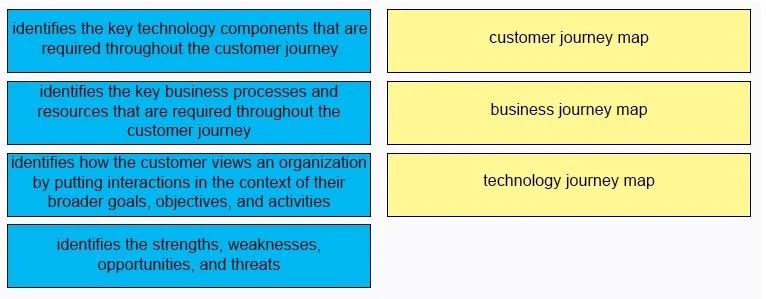
Drag and Drop Question Drag and drop the descriptions from the left onto the correct maps on the right. Not all options are used. Answer:
The correct answer is customer journey map: identifies how the customer views an organization by putting interactions in the context of their broader goals, objectives, and activities; business journey map: identifies the key business processes and resources that are required throughout the customer journey.; technology journey map: identifies the key technology components that are required throughout the customer journey.; identifies the strengths, weaknesses, opportunities, and threats. Journey Map Types - Explanation This question tests your ability to distinguish between three complementary journey map frameworks, plus recognize a distractor. --- The Three Maps and Their Descriptions 1. Customer Journey Map → "identifies how the customer views an…
Question
Drag and Drop Question Drag and drop the descriptions from the left onto the correct maps on the right. Not all options are used. Answer:
Exhibit
Answer Area
Drag items
Correct arrangement
- customer journey map: identifies how the customer views an organization by putting interactions in the context of their broader goals, objectives, and activities
- business journey map: identifies the key business processes and resources that are required throughout the customer journey.
- technology journey map: identifies the key technology components that are required throughout the customer journey.
- identifies the strengths, weaknesses, opportunities, and threats
Explanation
Journey Map Types - Explanation
This question tests your ability to distinguish between three complementary journey map frameworks, plus recognize a distractor.
The Three Maps and Their Descriptions
1. Customer Journey Map → "identifies how the customer views an organization by putting interactions in the context of their broader goals, objectives, and activities"
The keyword here is "how the customer views" - this map is told from the customer's perspective. It captures the emotional and experiential lens: what the customer is trying to accomplish, what they feel, and how each touchpoint fits into their life/goals. It is the most externally focused of the three.
2. Business Journey Map → "identifies the key business processes and resources that are required throughout the customer journey"
Keywords: "business processes and resources". This map looks at the same journey but from the organization's internal perspective - what departments, workflows, and assets must operate behind the scenes to support each customer touchpoint. It bridges customer-facing interactions with operational reality.
3. Technology Journey Map → "identifies the key technology components that are required throughout the customer journey"
Keywords: "technology components". This map layers the technical infrastructure - systems, platforms, APIs, tools - that enable the journey. It answers: what tech stack must exist at each stage to deliver the experience?
The Distractor (Unused Item)
"Identifies the strengths, weaknesses, opportunities, and threats" - this is the definition of a SWOT analysis, which is a completely different strategic framework unrelated to journey mapping. It is intentionally included to test whether you can recognize out-of-scope definitions.
Common Mistakes
| Mistake | Why it happens |
|---|---|
| Confusing customer ↔ business maps | Both reference the "customer journey," so candidates mix them. The differentiator is whose viewpoint - external (customer) vs. internal (org). |
| Assigning SWOT to any map | "Strengths/weaknesses" sounds like it could relate to a business map, but SWOT is a strategic analysis tool, not a journey mapping concept. |
| Swapping business ↔ technology maps | "Resources" in the business map can sound technical. The key distinction: business = processes and people/resources; technology = systems and components. |
Quick Memory Rule
Think of it as three layers stacked on the same journey:
- Customer = the why and experience (outside-in)
- Business = the who and what operationally (inside-out)
- Technology = the how technically (infrastructure layer)
Topics
Community Discussion
No community discussion yet for this question.