
840-450 · Question #64
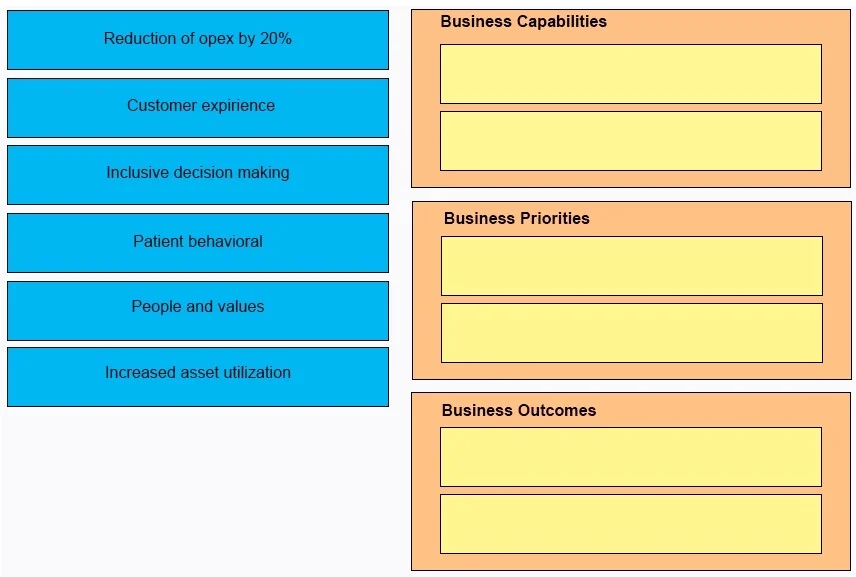
Drag and Drop Question Drag each item on the left to the appropriate category on the right. Answer:
The correct answer is identifies how the customer views an organization by putting interactions in the context of their broader goals, objectives, and activities; identifies the key business processes and resources that are required throughout the customer journey; identifies the key technology components that are required throughout the customer journey; identifies the strengths, weaknesses, opportunities, and threats. Drag-and-Drop Explanation: Customer Journey Analysis Frameworks This question maps descriptions to four distinct analytical frameworks used in customer experience (CX) and business analysis. The correct order corresponds to these named frameworks: | Position | Framework |…
Question
Drag and Drop Question Drag each item on the left to the appropriate category on the right. Answer:
Exhibit
Answer Area
Drag items
Correct arrangement
- identifies how the customer views an organization by putting interactions in the context of their broader goals, objectives, and activities
- identifies the key business processes and resources that are required throughout the customer journey
- identifies the key technology components that are required throughout the customer journey
- identifies the strengths, weaknesses, opportunities, and threats
Explanation
Drag-and-Drop Explanation: Customer Journey Analysis Frameworks
This question maps descriptions to four distinct analytical frameworks used in customer experience (CX) and business analysis. The correct order corresponds to these named frameworks:
| Position | Framework | Description Placed There |
|---|---|---|
| 1 | Experience Map | customer views / broader goals & activities |
| 2 | Service Blueprint | business processes & resources |
| 3 | Technology Map | key technology components |
| 4 | SWOT Analysis | strengths, weaknesses, opportunities, threats |
Position 1 - Experience Map
"identifies how the customer views an organization by putting interactions in the context of their broader goals, objectives, and activities"
An Experience Map is customer-centric - it captures the world from the customer's point of view, not the company's. The key signal in the description is "how the customer views" and "broader goals, objectives, and activities." It zooms out beyond individual touchpoints to understand the customer's life context.
Common mistake: Confusing this with a Customer Journey Map. A customer journey map tracks specific touchpoints; an experience map is broader - it contextualizes why the customer is interacting at all.
Position 2 - Service Blueprint
"identifies the key business processes and resources that are required throughout the customer journey"
A Service Blueprint is the operational backstage view - it maps what the organization must do (people, processes, policies) to deliver the customer experience. The phrase "business processes and resources" is the giveaway.
Common mistake: Mixing this up with the technology map. Blueprints are about people and process, not systems.
Position 3 - Technology Map
"identifies the key technology components that are required throughout the customer journey"
The Technology Map (sometimes called a System Map) catalogs the technical infrastructure - platforms, tools, integrations - that enable the journey. It's the IT layer sitting beneath the business processes.
Common mistake: Placing this before the Service Blueprint. You define the business processes first, then determine what technology is needed to support them. Process drives technology, not the other way around.
Position 4 - SWOT Analysis
"identifies the strengths, weaknesses, opportunities, and threats"
SWOT is a strategic assessment framework, not a journey-mapping tool. It sits last because it's evaluative - you use it to assess the insights gathered from the maps above. The definition is unmistakable: SWOT always means Strengths, Weaknesses, Opportunities, Threats.
Common mistake: Placing SWOT first. SWOT synthesizes findings; it doesn't initiate discovery.
The Logic of the Order
The arrangement follows a natural progression:
- Customer lens (what does the customer need/feel?) → Experience Map
- Business lens (what do we do to serve them?) → Service Blueprint
- Technology lens (what tools enable us?) → Technology Map
- Strategic lens (how are we positioned overall?) → SWOT
Topics
Community Discussion
No community discussion yet for this question.