
800-150 · Question #82
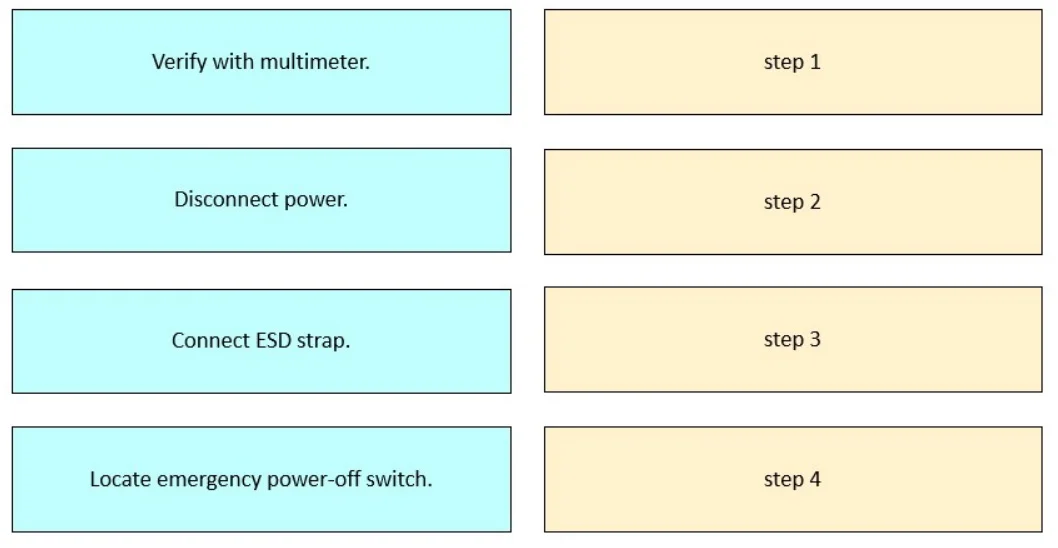
Drag and Drop Question Drag and drop the safety actions that must be taken prior to beginning work into order on the right for working with electrical equipment. Answer:
The correct answer is Locate emergency power-off switch.; Disconnect power.; Verify with multimeter.; Connect ESD strap. Electrical Safety Pre-Work Procedure: Order Explained The sequence follows a logical progression: prepare for emergencies → eliminate hazards → confirm safety → protect components. --- 1. Locate emergency power-off switch - First Why first: Before touching anything, you need to…
Question
Drag and Drop Question Drag and drop the safety actions that must be taken prior to beginning work into order on the right for working with electrical equipment. Answer:
Exhibit
Answer Area
Drag items
Correct arrangement
- Locate emergency power-off switch.
- Disconnect power.
- Verify with multimeter.
- Connect ESD strap.
Explanation
Electrical Safety Pre-Work Procedure: Order Explained
The sequence follows a logical progression: prepare for emergencies → eliminate hazards → confirm safety → protect components.
1. Locate emergency power-off switch - First
Why first: Before touching anything, you need to know your escape route if something goes wrong. If an accident occurs during any subsequent step, you need to be able to cut power instantly without searching. This is a preparatory safety awareness step, not an action that changes the electrical state.
Common mistake: People assume this is unimportant because they're about to disconnect power anyway. The point is situational awareness before you're in a potentially dangerous position.
2. Disconnect power - Second
Why second: Now that you know where the emergency shutoff is, you actively remove the power source. This is the primary hazard-elimination step - no current means no electrocution risk.
Common mistake: Skipping straight to this step without locating the emergency shutoff first, or disconnecting only the nearest breaker without tracing the full circuit.
3. Verify with multimeter - Third
Why third: Disconnecting power does not guarantee zero voltage. Capacitors can hold charge, circuits can have multiple feeds, or the wrong breaker may have been tripped. The multimeter confirms the disconnection was effective. This step validates step 2.
Common mistake: Trusting that "power off" means "no voltage." This is one of the most dangerous assumptions in electrical work.
4. Connect ESD strap - Last
Why last: An ESD (electrostatic discharge) strap protects sensitive components from static damage - it's a component-protection measure, not a personal safety measure. It's only relevant once the circuit is confirmed de-energized. Connecting it earlier is pointless and potentially confusing.
Common mistake: Treating the ESD strap as a personal electrical safety device. It is not rated for live circuits and provides no shock protection.
Summary Logic
| Step | Category | Protects |
|---|---|---|
| Locate EPO | Emergency preparedness | You (if something goes wrong) |
| Disconnect power | Hazard elimination | You (from shock) |
| Verify with multimeter | Hazard confirmation | You (from residual voltage) |
| Connect ESD strap | Component protection | The equipment (from static) |
The first three steps protect you; the last protects the hardware. Personal safety always precedes component safety.
Topics
Community Discussion
No community discussion yet for this question.