
70-663 · Question #49
Your company has a Active Directory forest. The forest contains two sites named Site1 and Site2. You plan to deploy Exchange Server 2010 servers in both sites. You need to plan a high availability…
The correct answer is D. Deploy two mailbox servers in each site. CCR is non-existent in Exchange 2010 so the only viable solution is D. With Exchange 2010, we no longer have the concept of Local Continuous Replication (LCR), Single Copy Clusters (SCC), Cluster Continuous Replication (CCR) or Standby Continuous Replication (SCR) for that…
Question
Your company has a Active Directory forest. The forest contains two sites named Site1 and Site2. You plan to deploy Exchange Server 2010 servers in both sites. You need to plan a high availability subnet for the Mailbox servers that meets the following requirements:
- Users must be able to access their mailboxes if a single server fails
- Users must be able to access their mailboxes remotely if a single
site becomes unavailable What should you include in the plan?
Exhibit
Options
- ADeploy two Mailbox servers in each site.
- BDeploy one Mailbox server in Site1 and one Mailbox server in Site2.
- CDeploy one Mailbox server in Site1 and one Mailbox server in Site2.
- DDeploy two mailbox servers in each site.
How the community answered
(52 responses)- A12% (6)
- B6% (3)
- C4% (2)
- D79% (41)
Explanation
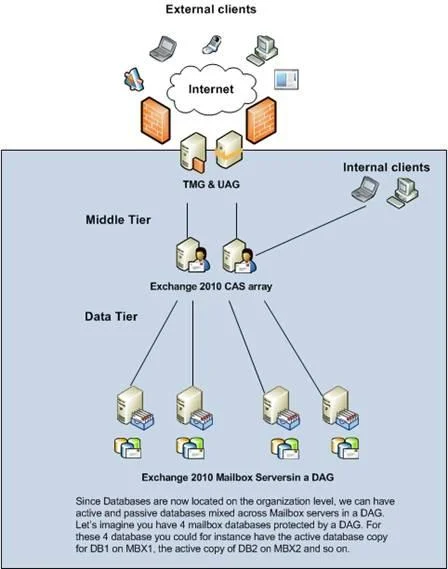
CCR is non-existent in Exchange 2010 so the only viable solution is D. With Exchange 2010, we no longer have the concept of Local Continuous Replication (LCR), Single Copy Clusters (SCC), Cluster Continuous Replication (CCR) or Standby Continuous Replication (SCR) for that matter. WHAT!? I hear some of you yell! Yes I am not kidding here. But to be more specific, only LCR and SCC have been removed from the Exchange Server product. CCR and SCR have been combined and have evolved into a more unified high availability framework in which the new Database Availability Group (DAG) act as the base component. This means that no matter if you are going to deploy a local or site-level highly available or disaster recoverable solution, you use a DAG. To make myself clear, with Exchange 2010, your one and only method to protect mailbox databases is by using DAG. recovery/uncovering-exchange-2010-database-availability-groups-dags-part1.html
Topics
Community Discussion
No community discussion yet for this question.