
4A0-107 · Question #65
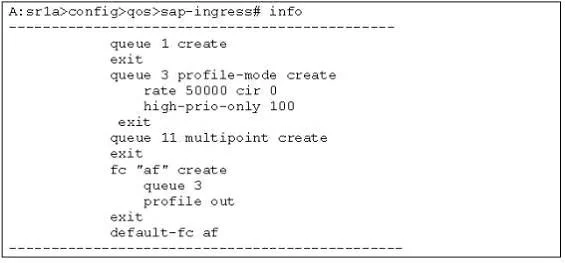
Click the exhibit button below. A service provider has applied the SAP-ingress policy configuration below on his customer's SAP. The service provider notices that all of the customer's traffic is…
The correct answer is C. Set the traffic classification of packets to in-profile. D. Set the high-priority-only value to 0. E. Map AF traffic to queue 1. In Nokia SR OS, when a SAP-ingress queue has a high-priority-only value set above 0, it reserves queue buffer exclusively for in-profile (high-priority) packets and drops all out-of-profile traffic - which explains why all customer traffic is being dropped. Setting traffic…
Question
Click the exhibit button below. A service provider has applied the SAP-ingress policy configuration below on his customer's SAP. The service provider notices that all of the customer's traffic is being dropped at the SAP-ingress. Which of the following actions can resolve the problem, if applied on its own? (Choose three)
Exhibit
Options
- ASet the CIR of queue 3 to a non-zero value corresponding to the customer's expected bandwidth
- BSet queue 3 to use priority mode.
- CSet the traffic classification of packets to in-profile.
- DSet the high-priority-only value to 0.
- EMap AF traffic to queue 1
How the community answered
(25 responses)- A8% (2)
- B12% (3)
- C80% (20)
Explanation
In Nokia SR OS, when a SAP-ingress queue has a high-priority-only value set above 0, it reserves queue buffer exclusively for in-profile (high-priority) packets and drops all out-of-profile traffic - which explains why all customer traffic is being dropped. Setting traffic classification to in-profile (C) fixes this because in-profile packets are never restricted by the high-priority-only threshold. Setting high-priority-only to 0 (D) removes the restriction entirely, allowing both in- and out-of-profile packets to use the queue. Mapping AF traffic to queue 1 (E) works because queue 1 presumably lacks the problematic high-priority-only restriction, so traffic no longer hits the broken queue 3.
Why A and B are wrong: A CIR of 0 (A) does not cause drops - it simply means no bandwidth is guaranteed, but traffic can still flow up to the PIR; the high-priority-only setting is the actual culprit. Priority mode (B) changes scheduling behavior between queues but does not affect packet admission or the high-priority-only drop mechanism.
Memory tip: Think of high-priority-only as a VIP-only door policy - if the bouncer only lets in VIPs (in-profile packets), everyone else gets dropped. You can fix it by making everyone a VIP (C), firing the bouncer (D), or using a different door with no policy (E). CIR and scheduling (A, B) are about the queue inside, not who gets past the door.
Topics
Community Discussion
No community discussion yet for this question.