
4A0-107 · Question #62
Click the exhibit button below. A network operator has configured the SAP-ingress policy below. Ping traffic is expected in queue 3. However, the network operator notices that all traffic is placed…
The correct answer is E. The SAP-ingress policy has not been applied to the SAP. Option E is correct because a SAP-ingress policy that is configured but not applied to the SAP has no operational effect - the SAP simply falls back to the default ingress policy, which maps all traffic to the Best Effort (BE) forwarding class and queues everything in queue 1…
Question
Click the exhibit button below. A network operator has configured the SAP-ingress policy below. Ping traffic is expected in queue 3. However, the network operator notices that all traffic is placed in queue 1. What is the most probable reason for this?
Exhibit
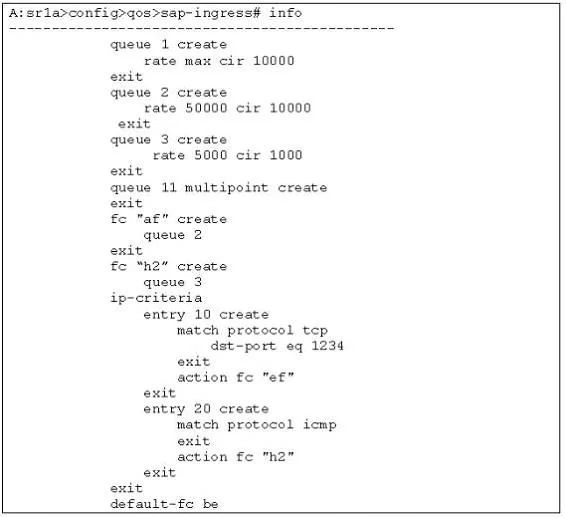
Options
- AThe default forwarding class for all traffic, including ICMP, is BE, which is placed in queue 1.
- BThe SAP has been shut down.
- CThe IP-match criteria has been misconfigured for ICMP traffic.
- DQueue 3 has no rate or CIR configured and thus cannot hold any packets.
- EThe SAP-ingress policy has not been applied to the SAP.
How the community answered
(40 responses)- A3% (1)
- B3% (1)
- C5% (2)
- D8% (3)
- E83% (33)
Explanation
Option E is correct because a SAP-ingress policy that is configured but not applied to the SAP has no operational effect - the SAP simply falls back to the default ingress policy, which maps all traffic to the Best Effort (BE) forwarding class and queues everything in queue 1, regardless of how the unattached policy is configured.
Why the distractors are wrong:
- A describes a symptom (BE traffic lands in queue 1) that is true by default, but it is the consequence of E, not an independent cause - if the policy were applied, ICMP would correctly reach queue 3.
- B is wrong because a shut-down SAP drops all traffic entirely; you wouldn't observe traffic landing anywhere.
- C could explain ping specifically landing in the wrong queue, but not why all traffic ends up in queue 1 - other classified traffic would still be placed correctly.
- D is factually incorrect; in Nokia SR OS, a queue without an explicit CIR/PIR still accepts packets using default best-effort scheduling.
Memory tip: Think of a QoS policy as a recipe that must be handed to the chef (the SAP) before it gets used. Writing the recipe (configuring the policy) and giving it to the kitchen (applying it) are two separate steps - configuration without application is the most common operator mistake on exams and in production.
Topics
Community Discussion
No community discussion yet for this question.