
4A0-107 · Question #99
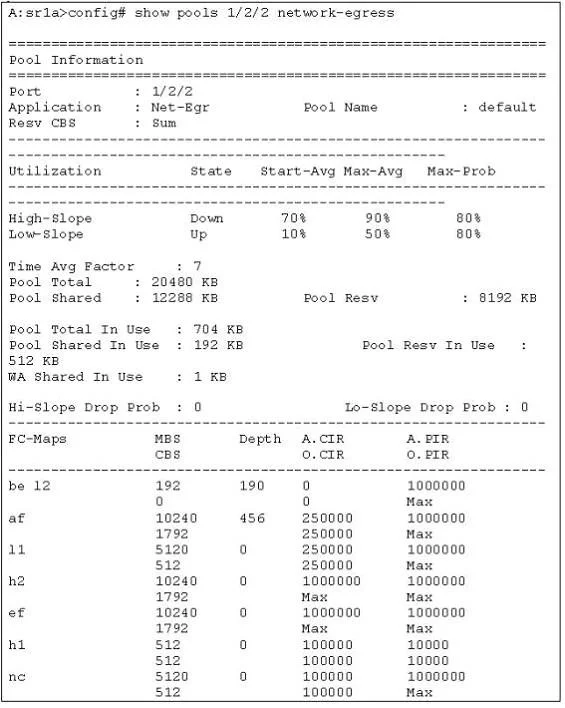
Click the exhibit button below. Given the output of the #show pools 1/2/2 network-egress command on a GigE port, what can the service provider deduce? (Choose two)
The correct answer is B. Packets in forwarding classes "be" and "12" are being queued. C. Traffic belonging to forwarding class "ef" is not experiencing queuing delays. Options B and C are correct because the show pools output on a GigE egress port reveals real-time queue depths per forwarding class: non-zero depth values for "be" (Best Effort) and "l2" (Loss Priority 2) confirm those packets are actively waiting in buffers, while a queue…
Question
Click the exhibit button below. Given the output of the #show pools 1/2/2 network-egress command on a GigE port, what can the service provider deduce? (Choose two)
Exhibit
Options
- AQoS is not configured on the router.
- BPackets in forwarding classes "be" and "12" are being queued.
- CTraffic belonging to forwarding class "ef" is not experiencing queuing delays.
- DTraffic belonging to forwarding class "11 "will never make use of the shared buffer pool.
- EOut-of-profile traffic in the shared buffer pool is being dropped.
How the community answered
(16 responses)- A6% (1)
- B75% (12)
- D6% (1)
- E13% (2)
Explanation
Options B and C are correct because the show pools output on a GigE egress port reveals real-time queue depths per forwarding class: non-zero depth values for "be" (Best Effort) and "l2" (Loss Priority 2) confirm those packets are actively waiting in buffers, while a queue depth of zero for "ef" (Expedited Forwarding) confirms EF traffic is being serviced immediately with no buffering delay - which is the expected behavior of a strict-priority class.
Why the distractors are wrong:
- A is wrong because the presence of per-forwarding-class pool statistics proves QoS is configured - traffic classification and queue separation require it.
- D is wrong because L1 traffic can access the shared buffer pool when its dedicated allocation is exhausted; only explicit configuration (e.g., a
no-shared-bufferpolicy) would prevent it, which cannot be inferred here. - E is wrong because a
show poolsoutput shows occupancy and queue depths, not drop statistics - you'd needshow class-of-service interfaceor RED drop counters to confirm active tail/RED drops.
Memory tip: Think of EF as a VIP lane - if show pools shows zero depth for EF, the VIP is never waiting. BE and L2 are coach class - if they show depth, they're queued up. The show pools command is a depth snapshot, not a drop report, so never conclude drops or QoS absence from it alone.
Topics
Community Discussion
No community discussion yet for this question.