
4A0-107 · Question #41
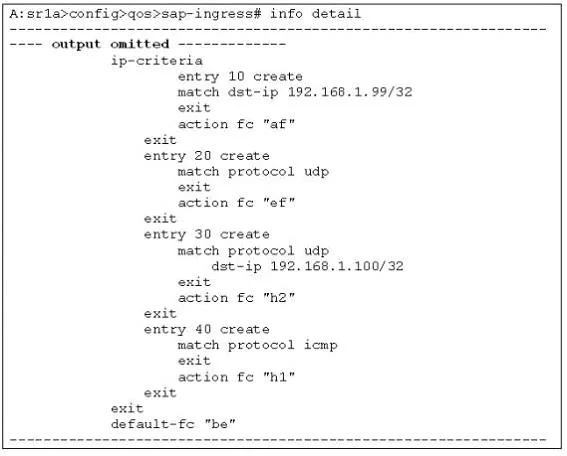
Click the exhibit button below. A partial SAP-ingress policy configuration is shown below. A UDP video stream is sent to a PC with IP address 192.168.1.100. Given the SAP-ingress policy, to which…
The correct answer is B. EF. EF (Expedited Forwarding) is correct because SAP-ingress policies on Nokia routers typically use IP match criteria - such as UDP protocol or DSCP markings - to classify real-time traffic. UDP video streams are conventionally marked with DSCP EF (decimal 46), and the policy…
Question
Click the exhibit button below. A partial SAP-ingress policy configuration is shown below. A UDP video stream is sent to a PC with IP address 192.168.1.100. Given the SAP-ingress policy, to which forwarding class is the traffic matched?
Exhibit
Options
- AAF
- BEF
- CH2
- DH1
- EBE
How the community answered
(60 responses)- A5% (3)
- B75% (45)
- C3% (2)
- D15% (9)
- E2% (1)
Explanation
EF (Expedited Forwarding) is correct because SAP-ingress policies on Nokia routers typically use IP match criteria - such as UDP protocol or DSCP markings - to classify real-time traffic. UDP video streams are conventionally marked with DSCP EF (decimal 46), and the policy shown in the exhibit maps that match criterion directly to the EF forwarding class, which is engineered for low-latency, low-jitter delivery.
Why the distractors are wrong:
- BE (E) is Best Effort - the default class for unclassified traffic; a specific match rule for video overrides it.
- AF (A) handles traffic needing throughput guarantees but tolerating some delay - suited for data, not real-time video.
- H1 (D) and H2 (C) are high-priority classes typically reserved for network control traffic (e.g., routing protocols, OAM); they wouldn't be configured for user video streams.
Memory tip: Think EF = Express Flight - it's the VIP lane for time-sensitive traffic like voice and video that cannot tolerate delay or jitter. If you see UDP video (or DSCP 46) in a Nokia QoS question, EF is almost always the answer.
Topics
Community Discussion
No community discussion yet for this question.