
4A0-107 · Question #42
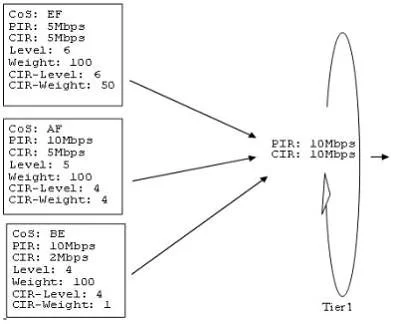
Click the exhibit button below. Given the scheduler-policy (below), how much bandwidth can the best-effort traffic receive (PIR and CIR) when the ingress rate of each queue is 10Mbps?
The correct answer is B. PIR = 1Mbps, CIR = 1 Mbps. Option B is correct because the scheduler policy sets a hard PIR cap on best-effort traffic equal to its CIR - both at 1Mbps - meaning the queue cannot burst beyond its committed rate regardless of available bandwidth or ingress rate. Even though each queue ingresses at 10Mbps…
Question
Click the exhibit button below. Given the scheduler-policy (below), how much bandwidth can the best-effort traffic receive (PIR and CIR) when the ingress rate of each queue is 10Mbps?
Exhibit
Options
- APIR = 4Mbps. CIR = 1Mbps
- BPIR = 1Mbps, CIR = 1 Mbps
- CPIR = 10Mbps, CIR = 1Mbps
- DPIR = 5Mbps, CIR = 1.25Mbps
- EPIR = 1.25Mbps, CIR = 1.25Mbps
How the community answered
(47 responses)- A2% (1)
- B79% (37)
- C4% (2)
- D13% (6)
- E2% (1)
Explanation
Option B is correct because the scheduler policy sets a hard PIR cap on best-effort traffic equal to its CIR - both at 1Mbps - meaning the queue cannot burst beyond its committed rate regardless of available bandwidth or ingress rate. Even though each queue ingresses at 10Mbps, the policy enforces a strict ceiling: best-effort gets exactly 1Mbps and no more.
Why the distractors fail:
- A (PIR=4Mbps): Implies best-effort can burst above its CIR to 4Mbps, but the policy's PIR cap prevents any excess borrowing.
- C (PIR=10Mbps): Suggests best-effort could absorb the full ingress rate, which would only be true if no PIR cap were configured.
- D (PIR=5Mbps, CIR=1.25Mbps): These values are arithmetically tempting (e.g., dividing total bandwidth by queue count) but don't reflect what the policy actually configures.
- E (PIR=1.25Mbps): Same miscalculation error as D - deriving rates by simple division rather than reading the explicit policy values.
Memory tip: When PIR = CIR for a queue, think "no burst allowed" - the scheduler has locked the door at the committed rate. If PIR > CIR, the queue can borrow; if PIR = CIR, it's a hard ceiling with zero headroom.
Topics
Community Discussion
No community discussion yet for this question.