
4A0-107 · Question #31
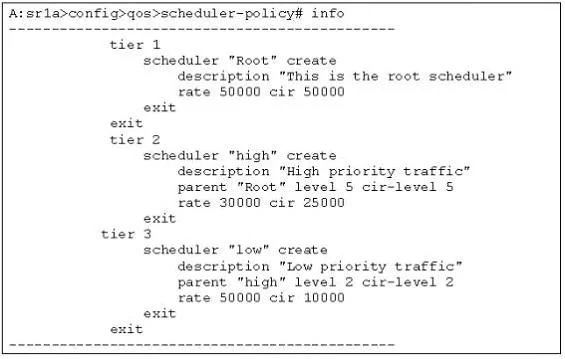
Click the exhibit button below. Given this scheduler-policy configuration, which of the following can be said about the scheduler called "high"? (Choose two)
The correct answer is A. It is a parent scheduler. D. It is a child scheduler. In hierarchical scheduling policies, a single scheduler can simultaneously occupy both a parent and a child role when it sits in the middle of the hierarchy. "High" is a child (D) because it has a scheduler above it (it is not at the root), and it is also a parent (A) because…
Question
Click the exhibit button below. Given this scheduler-policy configuration, which of the following can be said about the scheduler called "high"? (Choose two)
Exhibit
Options
- AIt is a parent scheduler.
- BIt is the top-level scheduler.
- CIt can allocate up to 50 Mbps of bandwidth to scheduler "low" since the bandwidth is not used by
- DIt is a child scheduler.
- EIt can only have queues as children.
How the community answered
(37 responses)- A84% (31)
- B3% (1)
- C5% (2)
- E8% (3)
Explanation
In hierarchical scheduling policies, a single scheduler can simultaneously occupy both a parent and a child role when it sits in the middle of the hierarchy. "High" is a child (D) because it has a scheduler above it (it is not at the root), and it is also a parent (A) because it has children (schedulers or queues) beneath it.
Why the distractors fail:
- B is wrong because the top-level scheduler has no parent - since "high" is a child (D), it cannot also be the root.
- C is wrong because unused bandwidth allocation rules depend on the specific policy configuration and parent-child relationships; "high" cannot arbitrarily donate its unused bandwidth to a sibling like "low."
- E is wrong because parent schedulers can have other schedulers as children (not just queues) - that's precisely why "high" qualifies as a parent.
Memory tip: Think of hierarchical schedulers like a corporate org chart - the CEO is top-level (no parent), entry-level staff are leaf nodes (no children/queues only), but a middle manager is both a child of the CEO and a parent of their team. If a scheduler is neither at the very top nor at a leaf, it's always both A and D.
Topics
Community Discussion
No community discussion yet for this question.