
400-007 · Question #38
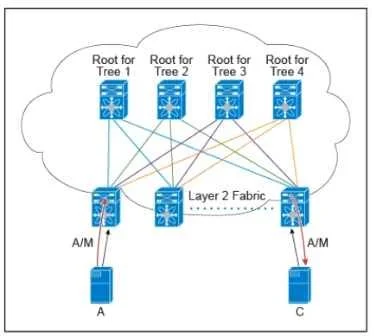
Refer to the exhibit. There are multiple trees in the Cisco FabricPath. All switches in the Layer 2 fabric share the same view of each tree. Which two concepts describe how the multicast traffic is…
The correct answer is B. All trees are utilized at the same level of the traffic rate D. A specific (S.G) multicast traffic is load-balanced across all trees due to better link utilization. In Cisco FabricPath, multiple multi-destination trees are built across the Layer 2 fabric. All switches in the fabric share a consistent view of each tree. Multicast traffic is load-balanced by assigning different (S,G) flows to different trees using a hash-based algorithm…
Question
Refer to the exhibit. There are multiple trees in the Cisco FabricPath. All switches in the Layer 2 fabric share the same view of each tree. Which two concepts describe how the multicast traffic is load-balanced across this topology? (Choose two )
Exhibit
Options
- AA specific (S.G) traffic is not load-balanced
- BAll trees are utilized at the same level of the traffic rate
- CEvery leaf node assigns the specific (S.G) to the same tree.
- DA specific (S.G) multicast traffic is load-balanced across all trees due to better link utilization
- EThe multicast traffic is generally load-balanced across all trees
How the community answered
(56 responses)- A9% (5)
- B64% (36)
- C21% (12)
- E5% (3)
Explanation
In Cisco FabricPath, multiple multi-destination trees are built across the Layer 2 fabric. All switches in the fabric share a consistent view of each tree. Multicast traffic is load-balanced by assigning different (S,G) flows to different trees using a hash-based algorithm - every switch in the fabric applies the same hash, so they all agree on which tree carries which (S,G). Choice B is correct because, with enough (S,G) flows distributed across the available trees, all trees end up carrying traffic - the hash distributes the load so that no single tree is idle while others are congested. Choice D is correct because the mechanism of mapping each (S,G) to a specific tree results in effective load balancing across the entire fabric, achieving better link utilization than a traditional single-tree (STP) model would allow. Choice A is partially true (a given individual (S,G) flows on exactly one tree, not all trees simultaneously), but this reflects the per-flow mechanism rather than the load-balancing outcome. Choice C is also true (all leaf nodes assign the same (S,G) to the same tree), but it describes the consistency property rather than how load balancing is achieved. Choice E is a general statement that is less precise than B and D in explaining the actual mechanism.
Topics
Community Discussion
No community discussion yet for this question.