
400-007 · Question #326
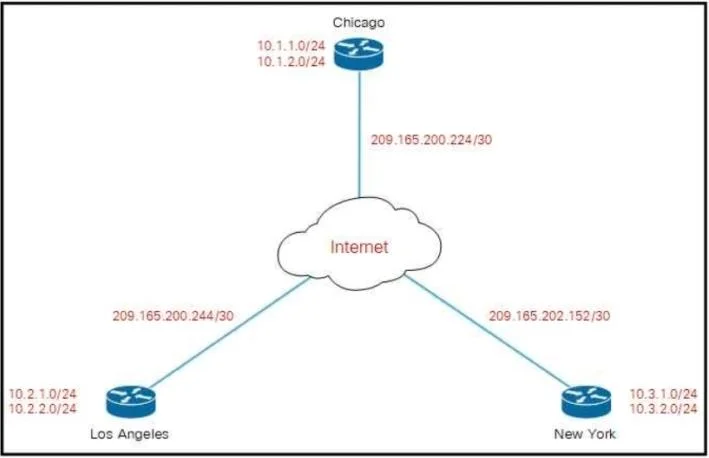
Refer to the exhibit. Company XYZ must design a DMVPN tunnel between the three sites. Chicago is going to act as the NHS and the company wants DMVPN to detect peer endpoint failures. Which…
The correct answer is B. IP SLA. In DMVPN, IP SLA actively probes peer endpoints to detect hub or spoke failures that passive GRE keepalives alone cannot reliably identify.
Question
Refer to the exhibit. Company XYZ must design a DMVPN tunnel between the three sites. Chicago is going to act as the NHS and the company wants DMVPN to detect peer endpoint failures. Which technology should be used in the design?
Exhibit
Options
- AVPLS
- BIP SLA
- CGRE
- DL2TPv3
How the community answered
(60 responses)- A3% (2)
- B93% (56)
- C2% (1)
- D2% (1)
Why each option
In DMVPN, IP SLA actively probes peer endpoints to detect hub or spoke failures that passive GRE keepalives alone cannot reliably identify.
VPLS is a Layer 2 multipoint Ethernet VPN technology and has no role in DMVPN tunnel monitoring or peer failure detection.
IP SLA uses echo probes to continuously monitor the reachability of DMVPN peer endpoints, including the NHS (hub). When a probe fails, IP SLA tracking can immediately update routing or tunnel state, enabling rapid failure detection independent of routing protocol convergence timers. This makes IP SLA the correct choice for detecting peer endpoint failures in a DMVPN design where Chicago acts as the NHS.
GRE is the encapsulation protocol underlying DMVPN tunnels but does not natively provide active peer endpoint failure detection on its own.
L2TPv3 is a Layer 2 tunneling protocol unrelated to DMVPN architecture and does not provide peer endpoint monitoring capabilities.
Concept tested: DMVPN peer endpoint failure detection using IP SLA
Source: https://www.cisco.com/c/en/us/td/docs/ios-xml/ios/iproute_pi/configuration/xe-16/iri-xe-16-book/iri-ip-sla.html
Topics
Community Discussion
No community discussion yet for this question.