
400-007 · Question #168
Refer to the exhibit A service provider has a requirement to use Ethernet OAM to detect end-to- end connectivity failures between SP-SW1 and SP- SW2. Which two ways to design this solution are true?…
The correct answer is B. Enable Connectivity Fault Management on the SP switches C. Use upward maintenance endpoints on the SP switches. Detecting end-to-end connectivity failures between SP switches requires enabling CFM (IEEE 802.1ag) and configuring upward-facing MEPs on the SP switches to generate and receive CCMs across the VPLS domain.
Question
Refer to the exhibit A service provider has a requirement to use Ethernet OAM to detect end-to- end connectivity failures between SP-SW1 and SP- SW2. Which two ways to design this solution are true? (Choose two)
Exhibit
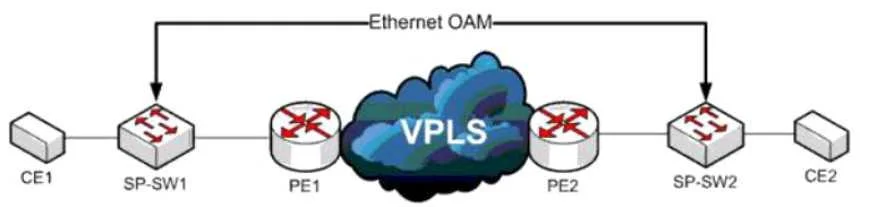
Options
- AEnable unicast heartbeat messages to be periodically exchanged between MEPs
- BEnable Connectivity Fault Management on the SP switches
- CUse upward maintenance endpoints on the SP switches
- DForward E-LMI PDUs over VPLS
- EForward LLD PDUs over the VPLS
How the community answered
(27 responses)- A11% (3)
- B78% (21)
- D4% (1)
- E7% (2)
Why each option
Detecting end-to-end connectivity failures between SP switches requires enabling CFM (IEEE 802.1ag) and configuring upward-facing MEPs on the SP switches to generate and receive CCMs across the VPLS domain.
CCMs used by CFM are sent as multicast frames to a well-known group address, not as unicast heartbeat messages; unicast is used for loopback/linktrace messages, not continuity checks.
Connectivity Fault Management (CFM) defined in IEEE 802.1ag is the standard Ethernet OAM toolset that provides end-to-end continuity checking via Continuity Check Messages (CCMs) exchanged between MEPs, making it the correct protocol to enable on the SP switches for this requirement.
Upward MEPs are configured on a bridge port facing toward the network (core) side, which is the correct MEP direction for SP switches that need to detect connectivity across the provider backbone - they send CCMs upward into the VPLS transport network toward the remote SP switch MEP.
E-LMI (Ethernet Local Management Interface) is a UNI-level protocol used between a CE and PE device for service parameter signaling, not for detecting connectivity between SP switches.
LLDP (Link Layer Discovery Protocol) is a neighbor discovery protocol operating at the link level and is not an OAM protocol designed for end-to-end connectivity fault detection across a VPLS domain.
Concept tested: Ethernet CFM MEP configuration for end-to-end OAM
Source: https://www.cisco.com/c/en/us/td/docs/ios-xml/ios/cether_oam_cfm/configuration/xe-16/ce-oam-cfm-xe-16-book/ce-oam-cfm-overview.html
Topics
Community Discussion
No community discussion yet for this question.