
400-007 · Question #126
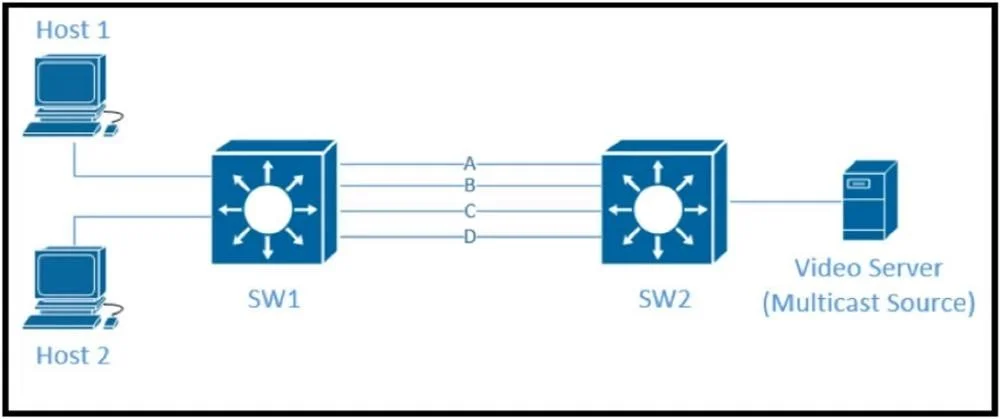
Refer to the exhibit. Traffic was equally balanced between Layer 3 links on core switches SW1 and SW2 before an introduction of the new video server in the network. This video server uses multicast…
The correct answer is B. Aggregate links Layer 2 link aggregation. Multicast traffic shares a single destination group IP, causing hash-based Layer 3 load balancing to pin all multicast flows to one link; Layer 2 aggregation resolves this by enabling MAC or port-based hashing across bundled links.
Question
Refer to the exhibit. Traffic was equally balanced between Layer 3 links on core switches SW1 and SW2 before an introduction of the new video server in the network. This video server uses multicast to send video streams to hosts and now one of the links between core switches is over utilized. Which design solution solves this issue?
Exhibit
Options
- AAdd more links between core switches.
- BAggregate links Layer 2 link aggregation.
- CApply a more granular load- balancing method on SW1.
- DApply a more granular load-balancing method on SW2.
- EFilter IGMP joins on an over -utilized link.
How the community answered
(25 responses)- A16% (4)
- B72% (18)
- C8% (2)
- D4% (1)
Why each option
Multicast traffic shares a single destination group IP, causing hash-based Layer 3 load balancing to pin all multicast flows to one link; Layer 2 aggregation resolves this by enabling MAC or port-based hashing across bundled links.
Adding more physical links without aggregation does not change the hash algorithm, so L3 load balancing will still map all same-destination multicast traffic to a single link.
Layer 2 link aggregation (EtherChannel/LACP) combines physical links into one logical bundle and can load-balance using source/destination MAC or other Layer 2 fields. Because multicast frames share one destination IP but can have varying source MACs and ports, the aggregation hash distributes them across member links instead of forcing them all to the same link as L3 IP-hash load balancing would.
SW1 load-balancing granularity cannot help if the root problem is that all multicast packets share the same destination IP, which any IP-hash method will resolve to the same link.
Adjusting SW2's load-balancing method alone does not address the upstream imbalance created by the multicast group's shared destination IP on the inter-switch links.
Filtering IGMP joins suppresses legitimate multicast group membership and denies video delivery to hosts rather than solving the link utilization imbalance.
Concept tested: Layer 2 link aggregation for multicast load distribution
Source: https://www.cisco.com/c/en/us/support/docs/lan-switching/etherchannel/12023-4.html
Topics
Community Discussion
No community discussion yet for this question.