
400-007 · Question #123
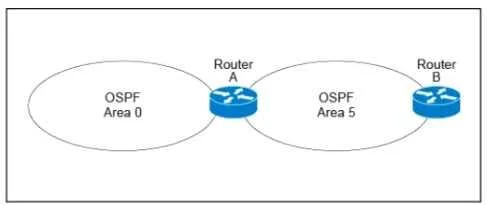
Refer to the exhibit. A customer runs OSPF with Area 5 between its aggregation router and an internal router. When a network change occurs in the backbone. Area 5 starts having connectivity issues…
The correct answer is B. Implement LSA filtering ontheAB, allowing summary routes and preventing more specific routes. LSA filtering at the ABR limits the LSAs entering Area 5 from the backbone, reducing SPF recalculations without requiring Router B to support stub areas.
Question
Refer to the exhibit. A customer runs OSPF with Area 5 between its aggregation router and an internal router. When a network change occurs in the backbone. Area 5 starts having connectivity issues due to the SPF algorithm recalculating an abnormal number of times in Area 5. You are tasked to redesign this network to increase resiliency on the customer network with the caveat that Router B does not support the stub area. How can you accomplish this task?
Exhibit
Options
- AIncrease the bandwidth on the connection between Router A and Router B
- BImplement LSA filtering ontheAB, allowing summary routes and preventing more specific routes
- CCreate a virtual link to Area 0 from Router B to the ABR
- DTurn on LSA throttling on all devices in Area 5
- ESet Area 5 to stubby at the ABR anyway
How the community answered
(54 responses)- A4% (2)
- B63% (34)
- C7% (4)
- D22% (12)
- E4% (2)
Why each option
LSA filtering at the ABR limits the LSAs entering Area 5 from the backbone, reducing SPF recalculations without requiring Router B to support stub areas.
Increasing the bandwidth between Router A and Router B has no effect on OSPF LSA flooding behavior or the rate of SPF recalculations in Area 5.
Configuring LSA filtering on the ABR to permit only summary routes and block more specific LSAs reduces the volume and specificity of topology changes propagated into Area 5, which directly lowers SPF recalculation frequency - achieving stub-like behavior without relying on Router B stub area support.
Creating a virtual link to Area 0 from Router B extends the backbone through Area 5 but does not filter LSAs or reduce SPF recalculations - it would likely increase topology exposure.
LSA throttling adjusts SPF and LSA timers to slow reactions but does not reduce the root cause - the volume of specific LSAs entering Area 5 from the backbone.
Setting Area 5 to stub at the ABR while Router B does not support stub areas causes OSPF hello option mismatches, breaking the adjacency between Router A and Router B entirely.
Concept tested: OSPF ABR LSA filtering to limit SPF recalculations
Source: https://www.cisco.com/c/en/us/support/docs/ip/open-shortest-path-first-ospf/8001-filtering.html
Topics
Community Discussion
No community discussion yet for this question.