
352-011 · Question #81
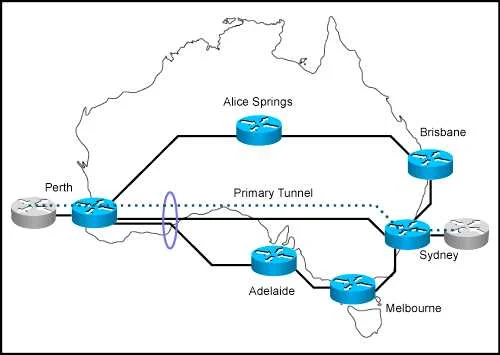
Refer to the exhibit. You are designing MPLS-TE for this network. The links form Perth to Sydney and from Perth to Adelaide share the same optical fiber in one given segment. Which feature should…
The correct answer is A. Shared Risk Link Groups. Shared Risk Link Groups (SRLGs) solve this exact problem by logically grouping links that share a common physical resource - in this case, the same optical fiber segment between Perth-Sydney and Perth-Adelaide. When MPLS-TE is aware of these groupings, it will not route a…
Question
Refer to the exhibit. You are designing MPLS-TE for this network. The links form Perth to Sydney and from Perth to Adelaide share the same optical fiber in one given segment. Which feature should you implement to eliminate the risk that a backup tunnel is installed over the same optical fiber as the primary one?
Exhibit
Options
- AShared Risk Link Groups
- BMPLS-TE Path Protection
- CMPLS-TE auto-tunnel backup
- DMPLS-TE Link protection
How the community answered
(25 responses)- A72% (18)
- B16% (4)
- C8% (2)
- D4% (1)
Explanation
Shared Risk Link Groups (SRLGs) solve this exact problem by logically grouping links that share a common physical resource - in this case, the same optical fiber segment between Perth-Sydney and Perth-Adelaide. When MPLS-TE is aware of these groupings, it will not route a backup tunnel over any link belonging to the same SRLG as the primary, preventing both paths from failing simultaneously on a single fiber cut.
Why the distractors are wrong:
- B (Path Protection) pre-computes an end-to-end standby LSP, but without SRLG configuration, it has no awareness of shared physical infrastructure and may inadvertently select the same fiber for the backup path.
- C (Auto-tunnel Backup) automates FRR backup tunnel creation, but automation alone doesn't prevent the backup from traversing the same optical fiber - it needs SRLG information to constrain path selection.
- D (Link Protection) is an FRR mechanism that protects a single link hop-by-hop, but like the others, it doesn't inherently understand or avoid shared physical media without SRLG.
Memory tip: SRLG = "Same Risk, Link Group." When links share a risk (same fiber, same conduit, same duct), you group them so MPLS-TE treats them as a single point of failure and routes backups around the entire group.
Topics
Community Discussion
No community discussion yet for this question.