352-011 · Question #50
Refer to the exhibit, Which two design considerations should be implemented on the pseudowire between N-PE and U- PE routers for a loop-free hierarchical VPLS service? (Choose two)
H-VPLS Loop-Free Design: Spoke Pseudowire Considerations The correct answers are A and C. In Hierarchical VPLS, the N-PE sits in a full hub mesh with peer N-PEs, while U-PE routers connect via spoke pseudowires. Two complementary mechanisms are required on that spoke PW: Why A…
Question
Refer to the exhibit, Which two design considerations should be implemented on the pseudowire between N-PE and U- PE routers for a loop-free hierarchical VPLS service? (Choose two)
Exhibit
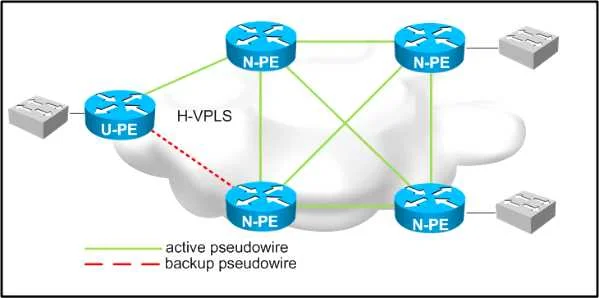
Options
- ADisable split horizon towards the U-PE router.
- BDisable MAC learning on the U-PE router.
- CEnable split horizon towards the N-PE routers.
- DDisable MAC learning on the U-PE routers.
- EDisable MAC learning on the U-PE routers.
- FEnable split horizon towards the U-PE routers.
- GDisable split horizon toward the N-PE routers.
Explanation
H-VPLS Loop-Free Design: Spoke Pseudowire Considerations
The correct answers are A and C.
In Hierarchical VPLS, the N-PE sits in a full hub mesh with peer N-PEs, while U-PE routers connect via spoke pseudowires. Two complementary mechanisms are required on that spoke PW:
Why A is correct - The N-PE must disable split horizon toward the U-PE so that hub/mesh traffic received from peer N-PEs is actually forwarded down the spoke PW to the U-PE. Standard VPLS split horizon blocks PW-to-PW forwarding; disabling it on the spoke side breaks that restriction and allows mesh replication to reach the U-PE.
Why C is correct - The U-PE must enable split horizon toward the N-PE so that traffic arriving on the N-PE spoke PW is never looped back upstream to the N-PE. This is the upstream guard that closes the loop the N-PE opened.
Why the distractors are wrong:
- B / D / E (Disable MAC learning on U-PE): MAC learning should stay enabled on U-PE so it can locally resolve MACs and avoid unnecessary flooding up to the N-PE; disabling it worsens scale and flooding.
- F (Enable split horizon toward U-PE): The opposite of A - it would prevent the N-PE from forwarding hub traffic to U-PE, breaking service entirely.
- G (Disable split horizon toward N-PE): The opposite of C - U-PE would forward traffic it received from N-PE back to N-PE, creating the very loop you're trying to prevent.
Memory tip: Think "N-PE opens the door down (disable SH toward U-PE), U-PE closes the door up (enable SH toward N-PE)" - traffic flows freely downward into the access layer, but is blocked from looping back up.
Topics
Community Discussion
No community discussion yet for this question.
