352-011 · Question #36
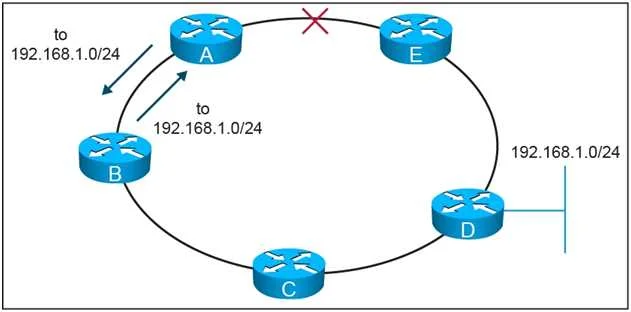
Refer to the exhibit. On this MPLS-based network ring, links have failed between router A and router E. These failures formed microloops while the network converged, when A forwarded traffic to B…
The correct answer is D. Remote Loop-Free Alternate. Remote Loop-Free Alternate (R-LFA) is correct because the scenario describes a ring topology where standard LFA fails - there is no local neighbor of A that satisfies the loop-free inequality (B would simply forward back to A). R-LFA solves this by tunneling traffic to a remote…
Question
Refer to the exhibit. On this MPLS-based network ring, links have failed between router A and router E. These failures formed microloops while the network converged, when A forwarded traffic to B but B forwards it back to
Exhibit
Options
- ATE Fast ReRoute
- BIP Fast ReRoute
- CLoop-Free Alternate
- DRemote Loop-Free Alternate
How the community answered
(18 responses)- A6% (1)
- B11% (2)
- C22% (4)
- D61% (11)
Explanation
Remote Loop-Free Alternate (R-LFA) is correct because the scenario describes a ring topology where standard LFA fails - there is no local neighbor of A that satisfies the loop-free inequality (B would simply forward back to A). R-LFA solves this by tunneling traffic to a remote "PQ node" that is guaranteed to be loop-free with respect to the failed destination, effectively bypassing the microloop without requiring pre-provisioned TE tunnels.
LFA (C) is wrong because it only evaluates direct neighbors as alternates; in a ring with a failure, the neighbor (B) fails the loop-free inequality check, so LFA has no valid repair and the microloop forms - this is precisely the gap R-LFA was designed to fill.
IP Fast ReRoute (B) is wrong because it is the overarching framework (RFC 5714), not a specific mechanism; LFA and R-LFA are both implementations of IP FRR, so choosing "IP FRR" is too generic to describe what actually resolves this failure.
TE Fast ReRoute (A) is wrong because it requires pre-signaled MPLS-TE backup tunnels; while effective, it is a traffic-engineering solution tied to RSVP-TE infrastructure, not a plain-IP convergence mechanism like R-LFA.
Memory tip: Associate "Remote" with "Ring" - when a ring topology breaks standard LFA because your only alternate neighbor loops back, R-LFA reaches past that neighbor via a tunnel to a remote loop-free repair point.
Topics
Community Discussion
No community discussion yet for this question.
