nerdexam
Cisco

352-011 · Question #82

Refer to the Exhibit. The server is running multiple VLANs on its NIC. Which two Layer 2 features should be applied to the network location identified by a circle? (Choose two)

PortFast trunk (F) and BPDU guard (B) are the correct answers for the switch port connecting to a server that trunks multiple VLANs. Why F and B are correct: Since the server uses 802.1Q tagging across its NIC, the connecting switch port must operate as a trunk - PortFast trunk…

Enterprise Network Design

Question

Refer to the Exhibit. The server is running multiple VLANs on its NIC. Which two Layer 2 features should be applied to the network location identified by a circle? (Choose two)

Exhibit
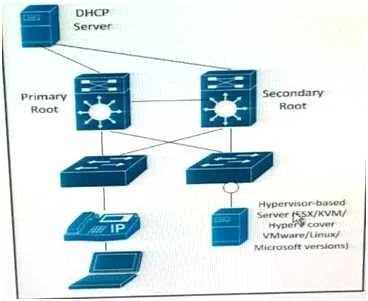
352-011 question #82 exhibit

Options

  • AUDLD
  • BBPDU guard
  • CBPDU filtering
  • DPort Fast
  • ELoop guard
  • FPortFast trunk

Explanation

PortFast trunk (F) and BPDU guard (B) are the correct answers for the switch port connecting to a server that trunks multiple VLANs.

Why F and B are correct: Since the server uses 802.1Q tagging across its NIC, the connecting switch port must operate as a trunk - PortFast trunk enables both PortFast behavior (bypassing STP listening/learning delays) and trunk mode simultaneously, which is exactly what a trunk-capable end device needs. BPDU guard is paired with PortFast ports to immediately err-disable the port if a BPDU is received, preventing a rogue switch from being plugged in and disrupting the topology.

Why the distractors are wrong:

  • D (PortFast): Regular PortFast is for access ports only; a server trunking VLANs requires the trunk variant (F), making D redundant and insufficient.
  • C (BPDU filtering): Silently drops BPDUs in both directions - dangerous because it can mask loops; not a recommended practice on edge ports.
  • A (UDLD): Detects unidirectional physical link failures; useful on fiber uplinks between switches, not specifically relevant here.
  • E (Loop guard): Protects non-designated ports from losing BPDUs and falsely transitioning to forwarding; applies to inter-switch links, not server-facing ports.

Memory tip: Think "trunk server = PortFast Trunk + BPDU guard" - the T keeps the server from waiting on STP, and the B blocks any rogue switch from hijacking that fast path.

Topics

#PortFast#BPDU Guard#STP Optimization#Trunk Ports

Community Discussion

No community discussion yet for this question.

Full 352-011 Practice