
352-011 · Question #34
Refer to the Exhibit. In which three Layers should you use nonstop Forwarding to reduce service impact in case of failure? (Choose three)
Nonstop Forwarding (NSF) - Correct Answer: A, B, C NSF belongs in the three routed layers - Enterprise Edge (A), Enterprise Core (B), and Service Provider Edge (C) - because NSF is a control-plane resilience feature that only has value where Layer 3 routing protocols (OSPF…
Question
Refer to the Exhibit. In which three Layers should you use nonstop Forwarding to reduce service impact in case of failure? (Choose three)
Exhibit
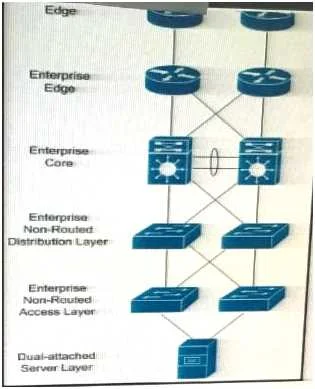
Options
- AEnterprise Edge
- BEnterprise Core
- CService provider Edge
- DDual-attached sever Layer
- EEnterprise Non-Routed Access Layer
- FEnterprise Non-Routed Distribution Layer.
Explanation
Nonstop Forwarding (NSF) - Correct Answer: A, B, C
NSF belongs in the three routed layers - Enterprise Edge (A), Enterprise Core (B), and Service Provider Edge (C) - because NSF is a control-plane resilience feature that only has value where Layer 3 routing protocols (OSPF, BGP, EIGRP, IS-IS) are actively running. When a supervisor or routing process fails, NSF allows the data plane to keep forwarding packets using cached routes while the routing process restarts, preventing traffic outages in high-throughput, routed segments.
Why the distractors are wrong:
- D (Dual-attached Server Layer) - typically a Layer 2 access construct; servers connect via port channels or bonded NICs, not routed adjacencies, so NSF offers no benefit.
- E (Enterprise Non-Routed Access Layer) - the word Non-Routed is the giveaway; it operates at Layer 2, so there are no routing adjacencies to preserve.
- F (Enterprise Non-Routed Distribution Layer) - same reasoning as E; without Layer 3 routing, NSF has nothing to protect.
Memory tip: The key phrase is "Non-Routed" - any layer with that label in the answer choices is automatically eliminated from NSF consideration. NSF = routing protocols = routed layers only. Think: "NSF lives where routes live."
Topics
Community Discussion
No community discussion yet for this question.