
352-001 · Question #571
Refer to the exhibit. Which solution must be used to send traffic from the foreign wireless LAN controller to the anchor wireless LAN controller?
The correct answer is A. Encapsulate packets into an EoIP tunnel and send them to the anchor controller. In Cisco WLC guest anchor deployments, the foreign controller encapsulates client traffic in an EoIP tunnel to forward it to the anchor controller.
Question
Refer to the exhibit. Which solution must be used to send traffic from the foreign wireless LAN controller to the anchor wireless LAN controller?
Exhibit
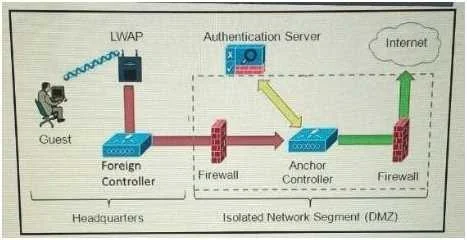
Options
- AEncapsulate packets into an EoIP tunnel and send them to the anchor controller
- BSend packets from the foreign controller to the anchor controller via Layer 3 MPLS VPN or VRF-
- CSend packets from the foreign controller to the anchor controller via IPinIP or IPsec tunnel
- DSend packets without encapsulation to the anchor controller over the routed network
How the community answered
(15 responses)- A80% (12)
- B13% (2)
- C7% (1)
Why each option
In Cisco WLC guest anchor deployments, the foreign controller encapsulates client traffic in an EoIP tunnel to forward it to the anchor controller.
EoIP (Ethernet over IP) tunneling is the Cisco-native mobility mechanism used between foreign and anchor WLCs; it encapsulates the full Ethernet frame and preserves client MAC and VLAN context across Layer 3 network boundaries between the two controllers, enabling seamless roaming and centralized policy enforcement at the anchor.
MPLS VPN and VRF are Layer 3 routing and segmentation technologies, not the tunnel mechanism that WLCs use natively for foreign-to-anchor client traffic forwarding.
IPinIP and IPsec are general-purpose IP tunneling protocols not natively used by Cisco WLCs for the foreign-to-anchor mobility tunnel; Cisco WLCs specifically use EoIP for this purpose.
Sending traffic without encapsulation would strip the Layer 2 Ethernet context needed to deliver traffic to the correct client session on the anchor controller, and the two controllers may reside on different Layer 3 segments.
Concept tested: Cisco WLC foreign-anchor EoIP mobility tunnel
Source: https://www.cisco.com/c/en/us/td/docs/wireless/controller/7-6/configuration-guide/b_cg76/b_cg76_chapter_0111001.html
Topics
Community Discussion
No community discussion yet for this question.