
352-001 · Question #557
Refer to the exhibit. As part of a redesign project, you must predict multicast behavior. What is the resultant multicast traffic receiving on the shared tree( , G), if it is received on the LHR…
The correct answer is B. It is switched due to a successful RPF check against the routing table. On a shared tree (*, G), the LHR performs an RPF check toward the RP using the unicast routing table, and if the packet arrives on the correct RPF interface, it is forwarded.
Question
Refer to the exhibit. As part of a redesign project, you must predict multicast behavior. What is the resultant multicast traffic receiving on the shared tree( , G), if it is received on the LHR interface indicated?
Exhibit
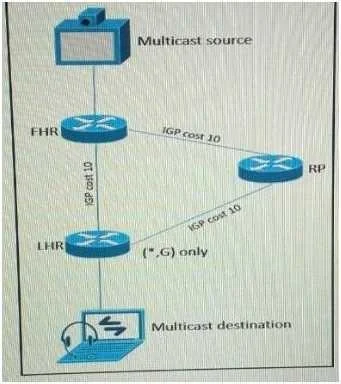
Options
- AIt is dropped due to an unsuccessful RPF check against the multicast receiver
- BIt is switched due to a successful RPF check against the routing table
- CIt is switched given that no RPF check is performed
- DIt is dropped due to an unsuccessful RPF check against the multicast source
How the community answered
(26 responses)- A4% (1)
- B65% (17)
- C12% (3)
- D19% (5)
Why each option
On a shared tree (*, G), the LHR performs an RPF check toward the RP using the unicast routing table, and if the packet arrives on the correct RPF interface, it is forwarded.
RPF checks in multicast routing are never performed against the multicast receiver - receivers are downstream and do not factor into RPF logic.
For shared tree (*, G) entries, the RPF check is performed against the unicast routing table to find the best path toward the Rendezvous Point (RP), not the source. If the multicast packet arrives on the interface that the router would use to reach the RP, the RPF check succeeds and the traffic is switched downstream. This is the standard PIM-SM behavior for shared tree forwarding on the LHR.
An RPF check is always performed on multicast traffic, including shared tree (*, G) entries; there is no scenario where multicast forwarding skips the RPF check entirely.
Checking RPF against the multicast source applies to source-specific (S, G) entries, not shared tree (*, G) entries, where the RPF lookup targets the RP address instead.
Concept tested: PIM-SM shared tree RPF check behavior
Source: https://www.cisco.com/c/en/us/td/docs/ios-xml/ios/ipmulti_pim/configuration/xe-16/imc-pim-xe-16-book/imc-pim-sm.html
Topics
Community Discussion
No community discussion yet for this question.