
350-501 · Question #550
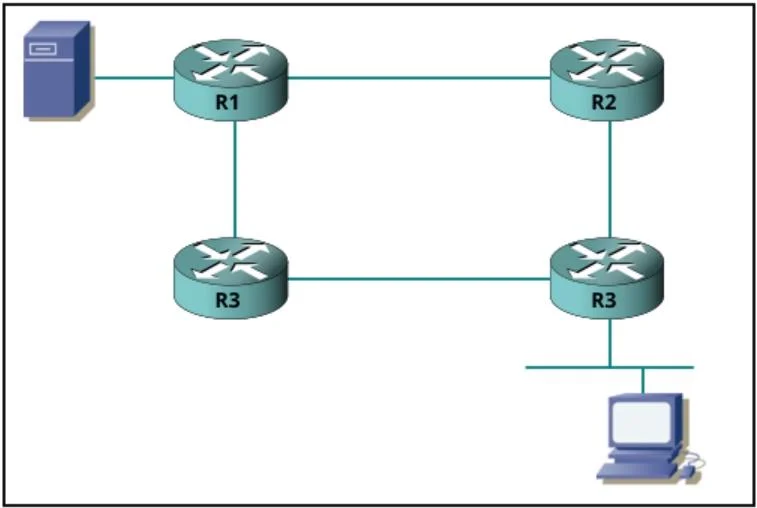
Refer to the exhibit. R1 is connected to a server that is used by hosts residing on R3. The networking team decided to implement real-time traffic monitoring on the Ethernet link between R1 and R4…
The correct answer is B. mib-retrieval D. interface TenGigE 0/1/0/0. To implement real-time traffic monitoring on the Ethernet link between R1 and R4 without affecting other segments, the engineer must configure the specific interface and enable MIB retrieval for data collection.
Question
Refer to the exhibit. R1 is connected to a server that is used by hosts residing on R3. The networking team decided to implement real-time traffic monitoring on the Ethernet link between R1 and R4 due to the traffic loss on the segment. Traffic on the other segments must not be affected by the solution. Which two configuration must the engineer apply to R1 on the interface connected to R4? (Choose two.)
Exhibit
Options
- Aethernet oam profile Profile_1
- Bmib-retrieval
- Cmep crosscheck
- Dinterface TenGigE 0/1/0/0
- Einterface TenGigE 0/1/0/0
How the community answered
(38 responses)- A3% (1)
- B74% (28)
- C8% (3)
- E16% (6)
Why each option
To implement real-time traffic monitoring on the Ethernet link between R1 and R4 without affecting other segments, the engineer must configure the specific interface and enable MIB retrieval for data collection.
Ethernet OAM (Operations, Administration, and Maintenance) profiles are used for link monitoring and fault management (e.g., connectivity fault management), but 'mib-retrieval' is more directly related to general real-time traffic statistics collection.
Enabling MIB retrieval allows the router to collect and expose real-time traffic statistics and operational data via SNMP, which can then be queried by monitoring tools to provide detailed insights into the link's performance and identify traffic loss. This is a common method for real-time monitoring.
MEP (Maintenance End Point) crosscheck is part of Ethernet CFM (Connectivity Fault Management) and is used for verifying connectivity and detecting faults, which is different from general real-time traffic monitoring for loss analysis.
Specifying 'interface TenGigE 0/1/0/0' is crucial as it targets the monitoring configuration to the exact link between R1 and R4, ensuring that other network segments remain unaffected. This command enters the interface configuration mode where `mib-retrieval` can be enabled.
The option 'interface TenGigE 0/1/0/0' is identical to option D. Assuming this is a duplicate or typo in the question, only one selection of the interface command is necessary, alongside the functional monitoring configuration.
Concept tested: Interface-specific real-time traffic monitoring using MIBs
Source: https://www.cisco.com/c/en/us/td/docs/iosxr/ncs5xx/ncs500/sys-mgmnt/73x/b-system-management-cg-ncs500-73x/b-system-management-cg-ncs500-73x_chapter_0110.html
Topics
Community Discussion
No community discussion yet for this question.