
350-501 · Question #549
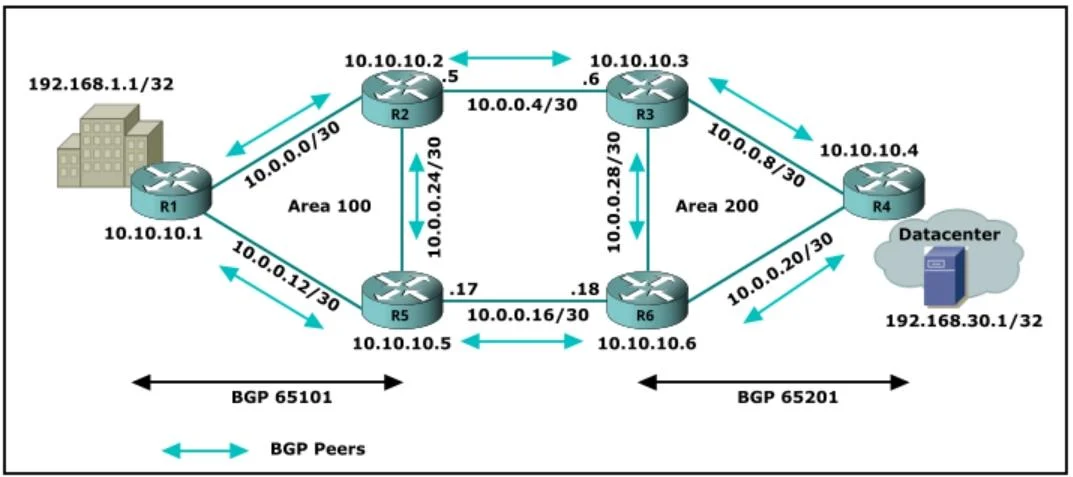
Refer to the exhibit. The operations team is implementing a route-map policy. Traffic from source 192.168.30.1 must reach the customer network 192.168.1.1 via the secondary link R4-R6-R5. All other…
The correct answer is D. Apply route-map Low-LP in on R4 with R3 BGP peering. To route specific traffic (192.168.30.1 to 192.168.1.1) via the secondary link (R4-R6-R5) while other traffic uses the primary link (R4-R3-R2), a route-map must be applied on R4 inbound from R3 to set a lower Local Preference for the specified prefix.
Question
Refer to the exhibit. The operations team is implementing a route-map policy. Traffic from source 192.168.30.1 must reach the customer network 192.168.1.1 via the secondary link R4-R6-R5. All other traffic from the data center to the customer network must prefer the primary link R4-R3-R2. Which action must be taken to meet the requirement for prefix 192.168.1.1/32?
Exhibit
Options
- AApply route-map PrefixBlock in on R6 with R5 BGP peering.
- BApply route-map PrefixBlock out on R3 with R4 BGP peering.
- CApply route-map High-LP on R6 with R4 BGP peering.
- DApply route-map Low-LP in on R4 with R3 BGP peering
How the community answered
(27 responses)- A19% (5)
- B4% (1)
- C11% (3)
- D67% (18)
Why each option
To route specific traffic (192.168.30.1 to 192.168.1.1) via the secondary link (R4-R6-R5) while other traffic uses the primary link (R4-R3-R2), a route-map must be applied on R4 inbound from R3 to set a lower Local Preference for the specified prefix.
Applying a route-map 'in' on R6 with R5 BGP peering would affect how R6 receives routes from R5, but it would not influence R4's decision on how to forward traffic towards 192.168.1.1/32 from the data center.
Applying a route-map 'out' on R3 with R4 BGP peering would affect what R3 advertises to R4, but the goal is to influence R4's path selection for traffic originating from the data center to a specific destination, which is better done by modifying R4's received routes.
Applying a route-map High-LP on R6 with R4 BGP peering would increase the Local Preference for routes R6 learns from R4, which is the opposite of what's needed to make R4 choose a path via R6 over R3 for specific traffic.
Applying a route-map with a Low-LP (Local Preference) 'in' on R4's BGP peering with R3 allows R4 to reduce the Local Preference for the specific prefix 192.168.1.1/32 when it learns it from R3. This makes R4 prefer the path to 192.168.1.1/32 learned from R6 (secondary link) instead, because BGP prefers paths with a higher Local Preference.
Concept tested: BGP route-map with Local Preference for path selection
Source: https://www.cisco.com/c/en/us/td/docs/ios-xml/ios/iproute_bgp/configuration/xe-3s/irr-xe-3s-book/bgp-att-lp.html
Topics
Community Discussion
No community discussion yet for this question.