
350-501 · Question #456
Refer to the exhibit. Four midsize service providers provide access to different customers that use Layer 3 VPN services to enable communication across geographic regions. The service providers are…
The correct answer is A. Configure a peering between all five Pes. The absence of routes learned by PE4 from PE5 on other PEs suggests an iBGP split-horizon issue within the service provider's AS. To ensure all PEs receive routes learned via iBGP, a full mesh iBGP peering among all five PEs or the use of route reflectors is required to…
Question
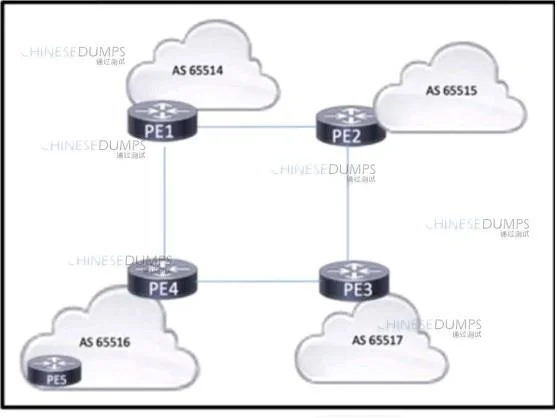
Refer to the exhibit. Four midsize service providers provide access to different customers that use Layer 3 VPN services to enable communication across geographic regions. The service providers are connected as shown in the exhibit, and the PEs have established eBGP relationships. PE4 has an IBGP relationship with PE5. The routes that PE4 learns from PE5 must reach the other PE routers, but they are absent from the routing tables on the other PES. Which action should the engineers take to correct the problem?
Exhibit
Options
- AConfigure a peering between all five Pes.
- BDisable BGP synchronization on PE4.
- CEnable BOP IPv4 unicast on PE4 and PE5
- DAdvertise the route targets for PE5 to the other PEs
How the community answered
(65 responses)- A80% (52)
- B12% (8)
- C2% (1)
- D6% (4)
Why each option
The absence of routes learned by PE4 from PE5 on other PEs suggests an iBGP split-horizon issue within the service provider's AS. To ensure all PEs receive routes learned via iBGP, a full mesh iBGP peering among all five PEs or the use of route reflectors is required to overcome the split-horizon rule.
In an iBGP network, the split-horizon rule prevents a router from advertising iBGP-learned routes to other iBGP peers to prevent routing loops. If PE4 and PE5 are within the same AS and PE4 learns routes from PE5 via iBGP, those routes will not be propagated to other iBGP peers (PE1, PE2, PE3) without a full iBGP mesh, route reflectors, or confederations. Configuring a peering between all five PEs implies establishing the necessary iBGP adjacencies to ensure all PEs learn routes from each other, thereby resolving the route propagation issue.
Disabling BGP synchronization typically resolves issues where an iBGP-learned route is not installed in the local IP routing table due to a lack of an IGP route. However, it does not address the iBGP split-horizon rule which prevents an iBGP router from advertising iBGP-learned routes to other iBGP peers.
Enabling BGP IPv4 unicast on PE4 and PE5 is a fundamental configuration for BGP to exchange routes at all. If routes are being learned by PE4 from PE5, this implies IPv4 unicast is already enabled and functioning, so it wouldn't resolve a propagation issue to other PEs.
Advertising route targets is specific to MPLS VPNs and governs which VPN routes are imported into a VRF. While related to L3 VPN services, the problem describes a general absence of "the routes" (likely VPNv4 routes) across PEs, suggesting a more fundamental BGP peering or propagation issue before route target policies become relevant.
Concept tested: iBGP split-horizon rule and full mesh requirement
Source: https://www.cisco.com/c/en/us/td/docs/ios-xml/ios/iproute_bgp/configuration/xe-16-5/bgp-xe-16-5-book/bgp-cfg-tasks.html#GUID-BC14D5BB-2244-4A3C-9A4B-37D19143719C
Topics
Community Discussion
No community discussion yet for this question.