
350-501 · Question #455
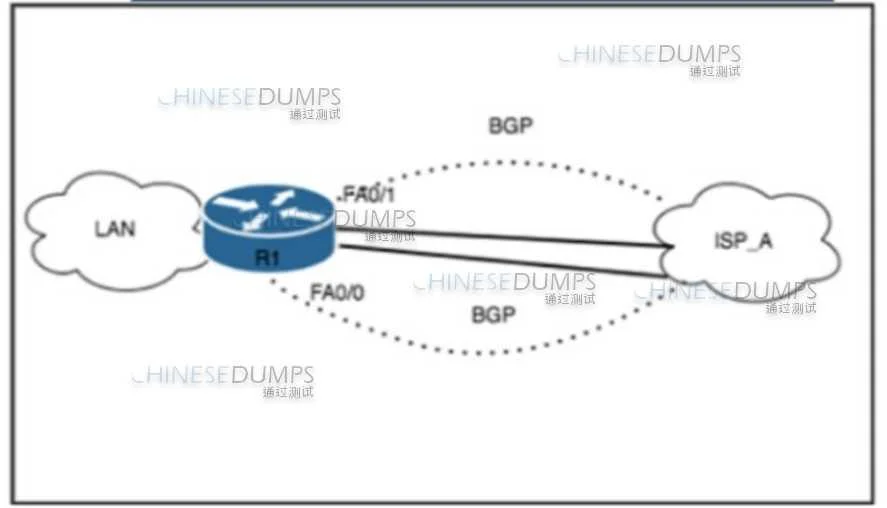
Refer to the exhibit. A network engineer must deny access from spoofed addresses to the LAN. The edge router currently has two active BGP sessions established with Tier 1 ISP_A. Due to asymmetric…
The correct answer is C. ip verify unicast source reachable-via any under FA0/1 E. ip verify unicast source reachable-via any under FA0/0. To deny access from spoofed addresses on an edge router with asymmetric routing, Unicast Reverse Path Forwarding (uRPF) must be enabled on both internet-facing interfaces. The reachable-via any mode is required for uRPF to correctly handle asymmetric routing paths and prevent…
Question
Refer to the exhibit. A network engineer must deny access from spoofed addresses to the LAN. The edge router currently has two active BGP sessions established with Tier 1 ISP_A. Due to asymmetric routing, no ACL is configured on either interface. Which two configurations must the engineer perform on the edge router to complete the task? (Choose two.)
Exhibit
Options
- Aip verify unicast source reachable-via tx under FA0/0
- Bip verify unicast source reachable-via under FA0/1
- Cip verify unicast source reachable-via any under FA0/1
- Dip verify unicast source reachable-via both under FA0/0
- Eip verify unicast source reachable-via any under FA0/0
How the community answered
(42 responses)- A7% (3)
- B2% (1)
- C79% (33)
- D12% (5)
Why each option
To deny access from spoofed addresses on an edge router with asymmetric routing, Unicast Reverse Path Forwarding (uRPF) must be enabled on both internet-facing interfaces. The `reachable-via any` mode is required for uRPF to correctly handle asymmetric routing paths and prevent legitimate traffic from being dropped.
The `ip verify unicast source reachable-via tx` syntax is incorrect or refers to a non-standard or deprecated mode; furthermore, a strict check (implied by `tx` or `rx`) would drop legitimate traffic in an asymmetric routing environment.
The command `ip verify unicast source reachable-via` is incomplete and lacks the necessary mode keyword (`any`, `rx`, `exists-only`) to configure uRPF properly.
The `ip verify unicast source reachable-via any` command configures Unicast Reverse Path Forwarding (uRPF) in loose mode on interface FA0/1. This mode checks if a route to the source IP address exists in the routing table via any interface, making it suitable for environments with asymmetric routing where ingress and egress paths may differ, while still dropping packets with spoofed source IPs that are not routable.
The `ip verify unicast source reachable-via both` syntax is incorrect; `both` is not a valid mode for uRPF configuration.
Similarly, `ip verify unicast source reachable-via any` on interface FA0/0 applies uRPF in loose mode to the other internet-facing interface. Implementing uRPF in `any` mode on both external interfaces (FA0/0 and FA0/1) ensures comprehensive protection against source IP spoofing without disrupting legitimate traffic that traverses asymmetric routes.
Concept tested: Unicast Reverse Path Forwarding (uRPF) and its modes
Source: https://www.cisco.com/c/en/us/td/docs/ios-xml/ios/security/a1/sec-a1-cr-book/sec-a1-cr-chapter-01.html#wp4166299839
Topics
Community Discussion
No community discussion yet for this question.