
350-501 · Question #454
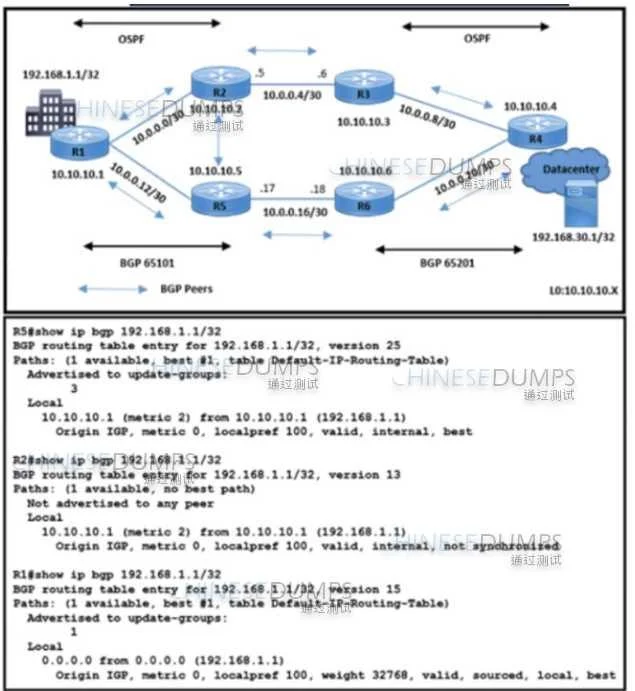
Refer to the exhibit. All BGP peering in AS 65101 and 65201 is enabled. The operations team is told that traffic destined to 192.168.1.1/32 from R4 does not use the path R3-R2-R1 as expected. An…
The correct answer is A. Enable no synchronization on R2 m AS65101. The issue where traffic from R4 doesn't use the R3-R2-R1 path for 192.168.1.1/32, despite R1 advertising the route, is likely caused by BGP synchronization being enabled on R2. Disabling synchronization (no synchronization) on R2 will allow it to install and advertise the…
Question
Refer to the exhibit. All BGP peering in AS 65101 and 65201 is enabled. The operations team is told that traffic destined to 192.168.1.1/32 from R4 does not use the path R3-R2-R1 as expected. An engineer debugs the issue and determines that 192.168.1.1/32 is advertised in the BGP routing table on R1. Which action resolves the issue?
Exhibit
Options
- AEnable no synchronization on R2 m AS65101.
- BApply route-map High-LP out for prefix 192.168.1.1/32 on R1 with R2 BGP peering.
- CApply redistribute ospf 10 on R1 in BGP AS 65101.
- DConfigure network 192.168.1.1 mask 255.255.255.255 in BGP AS 65101 on R2
How the community answered
(38 responses)- A71% (27)
- B13% (5)
- C11% (4)
- D5% (2)
Why each option
The issue where traffic from R4 doesn't use the R3-R2-R1 path for 192.168.1.1/32, despite R1 advertising the route, is likely caused by BGP synchronization being enabled on R2. Disabling synchronization (`no synchronization`) on R2 will allow it to install and advertise the iBGP-learned route from R1 even if it's not present in its IGP, enabling the expected traffic path.
The BGP synchronization rule dictates that an iBGP router will not install or advertise an iBGP-learned route to an eBGP peer unless that route is also known through an Interior Gateway Protocol (IGP). If `synchronization` is enabled on R2 and 192.168.1.1/32 is not in R2's OSPF routing table (despite being learned via iBGP from R1), R2 will not use or propagate this route, preventing R3 and subsequently R4 from learning the desired path. Disabling synchronization (`no synchronization`) on R2 bypasses this requirement, allowing the route to be correctly used and advertised through the AS.
Applying a route-map to modify Local Preference on R1 for R2 peering affects how R2 perceives routes learned from R1, primarily influencing path selection within the local AS, but it does not address the fundamental issue of R2 failing to install or advertise an iBGP-learned route due to synchronization.
The problem states that 192.168.1.1/32 is already advertised in R1's BGP table, meaning R1 is successfully originating the route into BGP. Redistributing OSPF into BGP on R1 would not resolve a synchronization issue on R2 for a route already in BGP.
Configuring a `network` statement on R2 for 192.168.1.1/32 would make R2 originate the route into BGP, potentially creating a different path, but it does not address why the existing route from R1 is not being utilized or propagated by R2, and it changes the point of origin.
Concept tested: BGP synchronization rule
Source: https://www.cisco.com/c/en/us/td/docs/ios-xml/ios/iproute_bgp/configuration/xe-16-5/bgp-xe-16-5-book/bgp-cfg-tasks.html#GUID-BC14D5BB-2244-4A3C-9A4B-37D19143719C
Topics
Community Discussion
No community discussion yet for this question.