
350-501 · Question #593
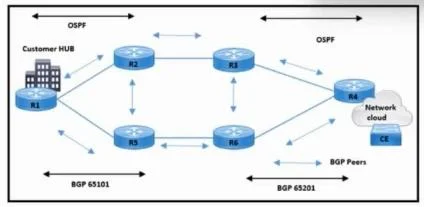
Refer to the exhibit. The NOC is configuring PE router R4 for BGP-originated traffic. R4 is connected to a CE device at a customer location. The customer requires: - BGP peers must establish a…
The correct answer is C. Set the BGP peering with ha-mode sso. To meet the Non-Stop Routing (NSR) requirement, the BGP peering must be configured with 'ha-mode sso', which ensures BGP state synchronization between redundant Route Processors for continuous operation during failover events.
Question
Refer to the exhibit. The NOC is configuring PE router R4 for BGP-originated traffic. R4 is connected to a CE device at a customer location. The customer requires:
- BGP peers must establish a neighborship with NSR and NSF capability.
- BGP must maintain state with the CE and provide continuous forwarding
during ISSU and RP switchover events. Which action meets the NSR requirement on PE routers?
Exhibit
Options
- ASet the BGP administrative distance to 15 for BGP neighbors.
- BSet the BGP restart-time to 120 seconds.
- CSet the BGP peering with ha-mode sso.
- DSet the BGP stalepath-time to 360 seconds.
How the community answered
(61 responses)- A2% (1)
- B3% (2)
- C92% (56)
- D3% (2)
Why each option
To meet the Non-Stop Routing (NSR) requirement, the BGP peering must be configured with 'ha-mode sso', which ensures BGP state synchronization between redundant Route Processors for continuous operation during failover events.
Setting the BGP administrative distance determines the preference of BGP routes compared to routes from other routing protocols, which is unrelated to Non-Stop Routing or Stateful Switchover.
The BGP restart-time is a parameter used in Non-Stop Forwarding (NSF) to specify how long an NSF-aware neighbor waits for a BGP speaker to reappear after a restart, rather than enabling the core NSR mechanism itself.
The 'neighbor <ip> ha-mode sso' command enables BGP Non-Stop Routing (NSR) by configuring Stateful Switchover (SSO) for the BGP session, ensuring the BGP state is fully synchronized between redundant Route Processors. This allows BGP sessions to remain active across an RP switchover, providing continuous forwarding and eliminating BGP reconvergence.
The BGP stalepath-time is also an NSF parameter that defines how long stale routes are kept in the RIB after a graceful restart, and it does not directly enable NSR.
Concept tested: BGP Non-Stop Routing (NSR) configuration
Source: https://www.cisco.com/c/en/us/td/docs/ios-xml/ios/iproute_bgp/configuration/xe-16-10/irg-xe-16-10-book/bgp-nsr.html
Topics
Community Discussion
No community discussion yet for this question.