
350-501 · Question #453
Refer to the exhbit. ISP A has a BGP peering with ISP C with the maximum-prefix 150 configuration on R1. After a recent security breach on the ISP A network, a network engineer has been asked to…
The correct answer is D. Configure neighbor 10.163.83.55 ttl-stcurity hops 2 under the global BGP configuration. To implement a lightweight security mechanism against spoofing attacks on R1's BGP membership and CPU, the ttl-security command should be configured for the BGP neighbor. This command protects against spoofed BGP connection attempts by verifying the Time-To-Live (TTL) value of…
Question
Refer to the exhbit. ISP A has a BGP peering with ISP C with the maximum-prefix 150 configuration on R1. After a recent security breach on the ISP A network, a network engineer has been asked to enable a lightweight security mechanism to protect the R1 CPU and BGP membership from spoofing attacks. Which solution must ISP A implement?
Exhibit
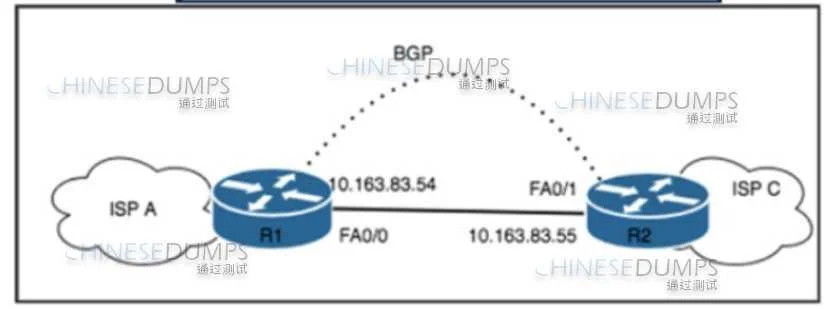
Options
- AConfigure bgp maxas-limit 1 in the IPv4 address family urateUhe global BGP configuration.
- BConfigure neighbor 10.163.83.54 enable-connected-check under the BGP IPv4 address family.
- CConfigure neighbor 10.163.83.55 password Cisco under the global BGP IPv4 address family.
- DConfigure neighbor 10.163.83.55 ttl-stcurity hops 2 under the global BGP configuration.
How the community answered
(44 responses)- A2% (1)
- B9% (4)
- C7% (3)
- D82% (36)
Why each option
To implement a lightweight security mechanism against spoofing attacks on R1's BGP membership and CPU, the `ttl-security` command should be configured for the BGP neighbor. This command protects against spoofed BGP connection attempts by verifying the Time-To-Live (TTL) value of incoming BGP packets.
The `bgp maxas-limit` command is a routing policy control that limits the number of ASNs in the AS-path attribute, which does not protect against connection-level spoofing attacks on the BGP session itself or the router's CPU.
The `enable-connected-check` command ensures that the neighbor is directly connected, which might not be compatible with eBGP multihop scenarios and does not offer robust protection against spoofing beyond verifying direct adjacency.
BGP MD5 authentication (`password`) protects against unauthorized BGP updates and ensures message integrity, which is a stronger security measure but might not be considered 'lightweight' in the same context as `ttl-security` which specifically targets the initial connection phase and CPU protection against spoofing attempts using TTL manipulation.
The `neighbor ttl-security hops` command leverages the BGP TTL security feature, which verifies the TTL value of incoming BGP packets from a specified neighbor. By expecting a specific TTL value (256 minus the number of hops), the router can identify and drop BGP packets from attackers attempting to spoof the BGP session from a different location, thereby protecting the R1 CPU from processing illegitimate connection attempts and securing the BGP membership. This is a lightweight and effective defense against certain types of spoofing attacks.
Concept tested: BGP TTL security for anti-spoofing
Source: https://www.cisco.com/c/en/us/td/docs/ios-xml/ios/iproute_bgp/command/bgp-cr-a1.html#wp3165768297
Topics
Community Discussion
No community discussion yet for this question.